
When DHM Research fielded a national survey for The Eastern Transportation Coalition (“the Coalition”) in early April 2026, we set out to get a fresh take on what Americans understand about how we pay for our roads — and how they think about mileage-based user fees (MBUFs) as a possible alternative. Here are some of the high-level findings.
Americans know they pay the gas tax, they just can’t tell you how much it is
Three-quarters of U.S. adults (75%) say they’re aware they pay state and federal gas tax every time they fill up. That sounds like a healthy baseline, until you press for specifics. Asked to guess the federal rate in cents per gallon, only 54% would venture an answer. Those who did landed on an average of 23.5 cents.
The actual federal rate is 18.4 cents per gallon. It has not changed since 1993.
Roughly half of Americans can’t or won’t name the most visible price signal in transportation funding, and the half who do overshoot reality by nearly 30%. For a policy community that has spent a generation explaining the erosion of the Highway Trust Fund, the gas tax has effectively gone invisible — and the public’s vague understanding of it, if anything, is more generous than the reality.
The transportation funding story is running in reverse
Asked whether transportation funding is increasing, staying the same, or decreasing, 42% of respondents said increasing. Only 17% said decreasing; 23% said staying the same; 19% weren’t sure.
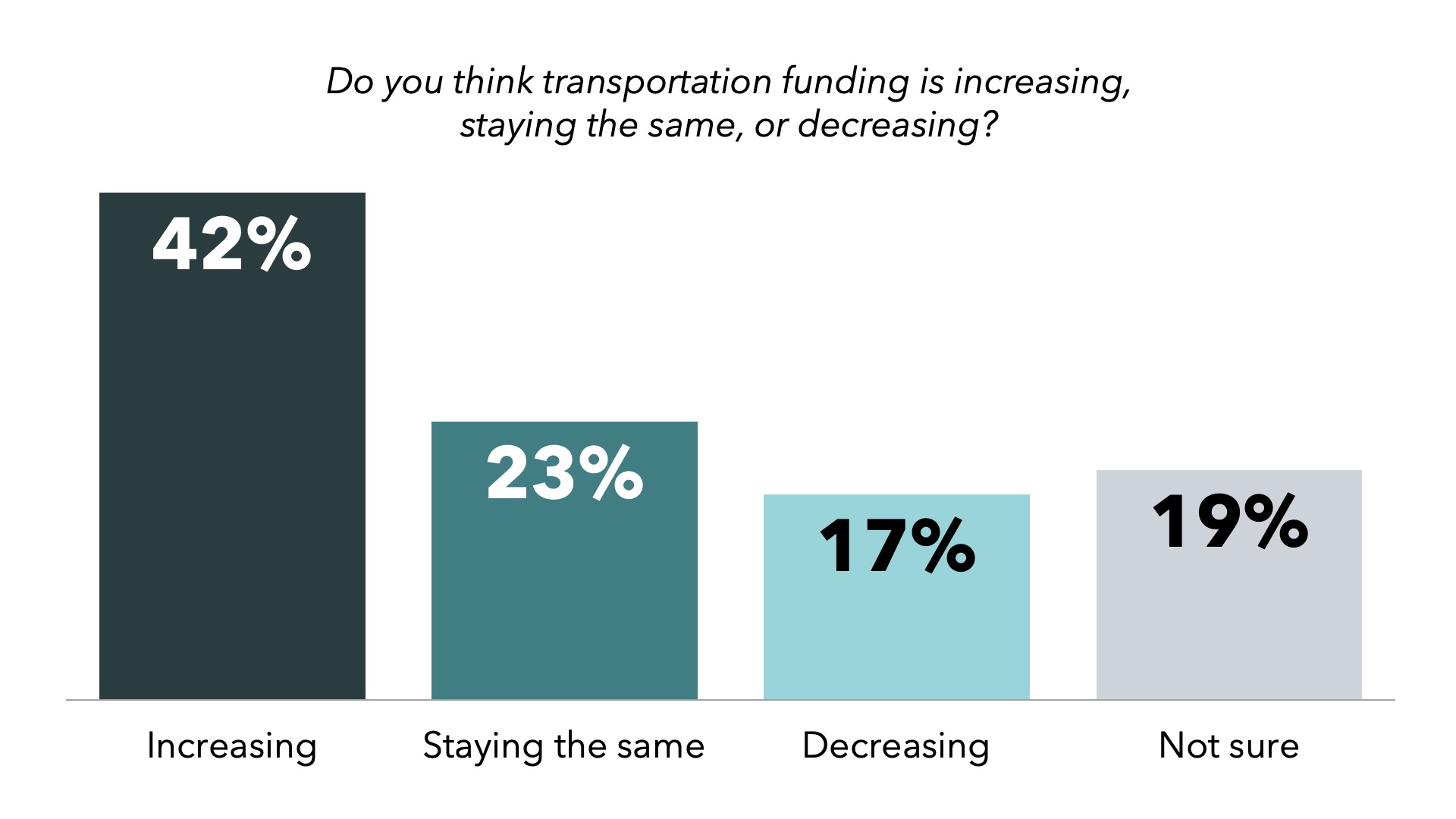
That’s roughly the inverse of reality. Anyone who has watched the Highway Trust Fund lean on general-fund transfers, or tracked the real-dollar purchasing power of an 18.4-cent gas tax against three decades of inflation and rising fuel economy, knows the trajectory has been down, not up. A plurality of Americans are wrong about the basic direction of the system they’re being asked to reform.
This is the deeper communications problem. Familiarity with MBUF can be built. A mistaken belief that the status quo is working is harder to dislodge, and yet it’s this misunderstanding that shapes every conversation about replacing the gas tax.
MBUF familiarity is still in the slow lane
Only one in three Americans (33%) say they are very or somewhat familiar with the concept of a mileage-based user fee. The “very familiar” sliver is just 8%, while 62% percent are not too or not at all familiar.
That tracks with what the Mineta Transportation Institute has documented in its long-running annual surveys: familiarity with mileage-based user fees has crept up over the past decade, but it’s limited outside of states that have actually put programs on the ground. In states where residents have direct exposure to MBUF (Hawaii, Oregon, Utah, Vermont, and Virginia), awareness and openness both move. In states where exposure is limited, familiarity stalls.
For the Coalition, which has run multi-state MBUF pilots across the eastern corridor for years, the data confirm what the organization has long understood: pilots and public education need to move in tandem. Pilots can put MBUF on the road, but public education is needed to explain why the gas tax can no longer carry the load it once did.
The road to MBUF is more open than the conventional wisdom suggests
Here’s where the survey findings get interesting. Asked whether an MBUF would be more fair, about the same, or less fair than the gas tax: 17% said more fair, 31% said about the same, 24% said less fair, and 28% weren’t sure.
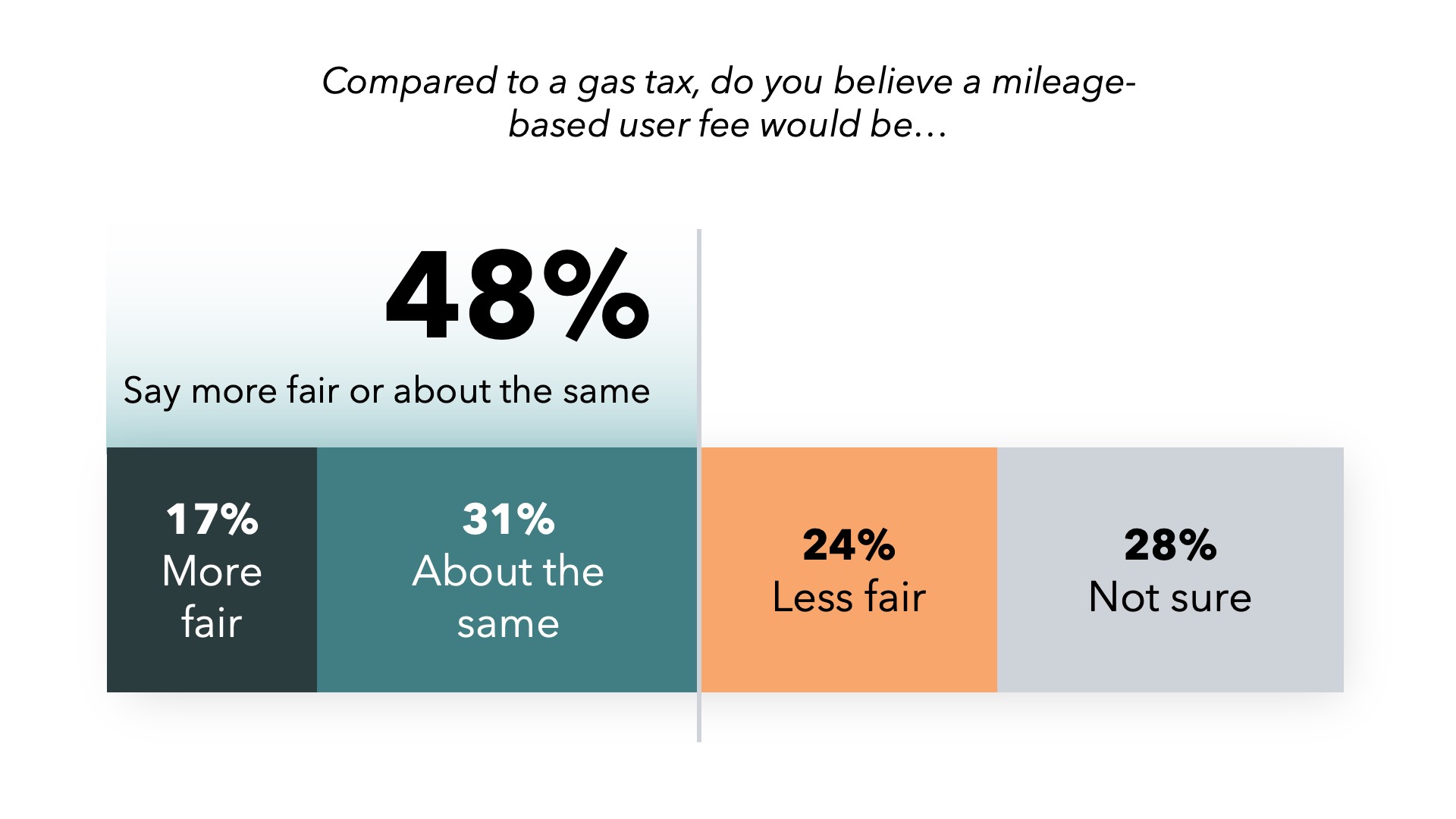
Read those numbers carefully. Nearly half of respondents (48%) say an MBUF would be at least as fair as the gas tax. Just under a quarter (24%) say less fair, and more than a quarter (28%) haven’t decided. This is not a public slamming the brakes on MBUF. It’s a public idling at the intersection, waiting for a reason to move.
That pattern tracks with what Mineta’s national work — and DHM’s state-by-state research — has shown for years. Support for mileage fees climbs sharply when respondents are told the fee would replace (rather than add to) the gas tax, and when privacy concerns are addressed up front. The “less fair” share is real and concentrated around key concerns (double taxation, privacy, potential impact on rural drivers), but it’s not a majority and it’s not insurmountable.
What this means for the road ahead
A few implications follow.
First, the communications challenge runs deeper than explaining how MBUF works. As long as a plurality of Americans believes road funding is growing, no reform will feel necessary. Repairing the public’s mental model of the gas tax has to be the foundation, not an afterthought.
Second, the fairness frame is winnable. The “less fair” share sits at less than a quarter, whereas “about the same,” “more fair,” and “not sure” together make up three-quarters of the public. The latter is the audience that the next round of pilots, voter education, and earned media could be aimed at. It’s a persuadable middle, not a hostile electorate.
Third, pilot exposure does the heavy lifting. The states with operational programs are pulling familiarity and acceptance up for everyone else. The Coalition’s eastern corridor work matters not just for technical learnings, but for raising the 33% familiarity floor.
The deeper point: the gas tax is fading as a “pay for what you use” signal. Vehicles go farther on a tank. EVs often pay nothing. A usage-based alternative isn’t just a fiscal solution, it’s a chance to restore the basic mental link between using a road and paying for it. The public is open to going down that road. Policymakers may just need to help pave the way.
Written by: Tony Iaccarino
About the Survey
The national survey was conducted by DHM Research April 2—9, 2026, among 666 U.S. adults. Margin of error: ±3.8%. DHM Research is a nonpartisan, independent opinion research firm specializing in research to support public policy making.