
Artificial intelligence, and the data centers that power it, are increasingly central to the economy and politics. While many communities once welcomed data centers for the jobs and local tax dollars they promised, more and more communities are now enacting bans on new development over energy and environmental impacts and doubts about the local economic benefits. Meanwhile, an increasing share of Americans says that AI does more harm than good.
However, despite the economic and political stakes of data centers and AI, we know little about what Oregonians expect from their elected leaders or the policies that voters support.
This survey asked Oregonians about their overall impressions of AI and data centers. Then it asked them to consider ten policies about AI and data centers, five of which were supportive and five restrictive. We asked survey takers to consider these policies in two ways. First, whether they thought the Democratic Party or Republican Party was more likely to take that policy position. Next, whether they personally supported or opposed the policy. We did this to understand how Oregonians see the partisan politics of AI and data centers, and how well that matches their own preferences.
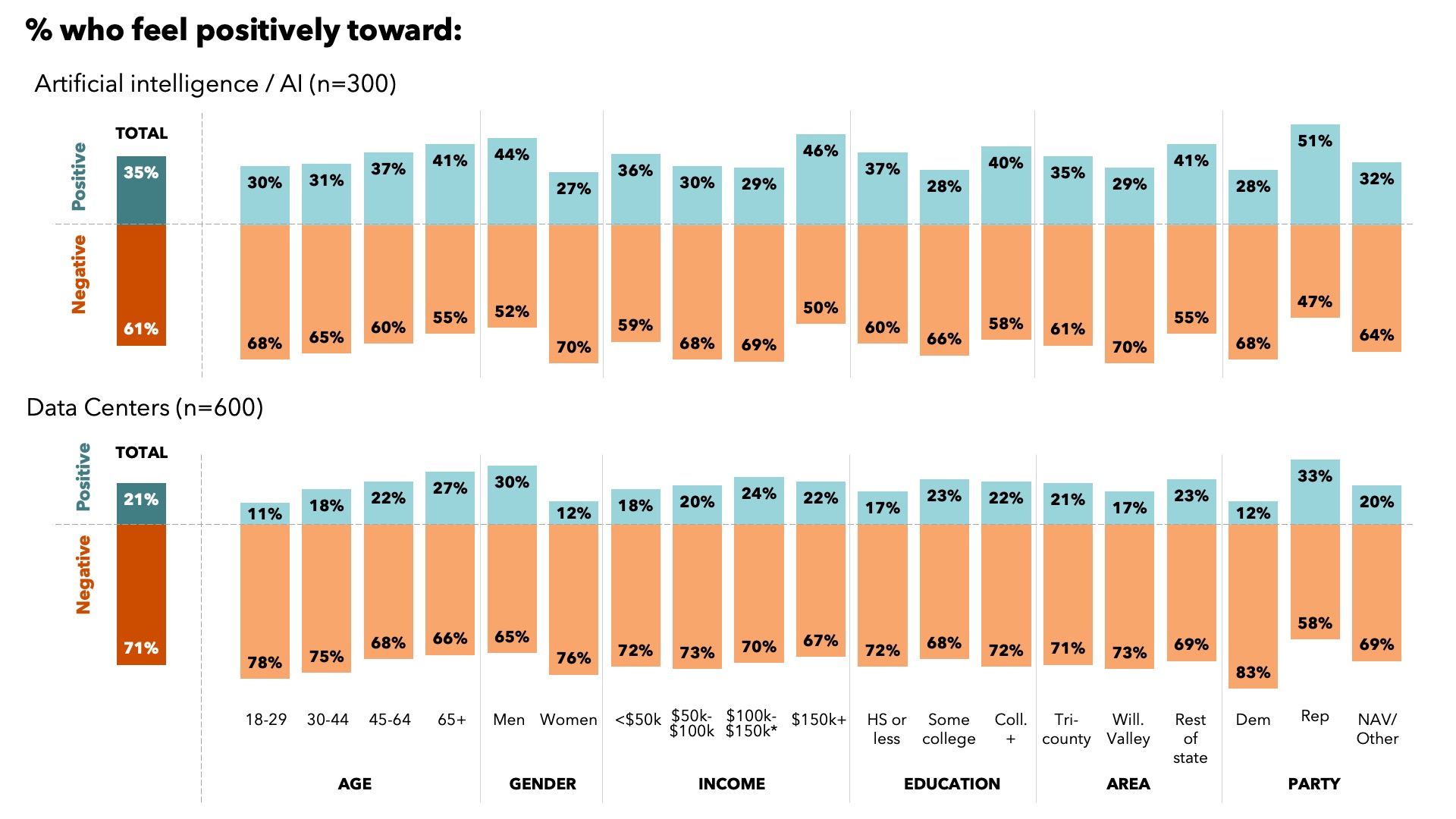
Most Oregonians have a negative view of AI and data centers, and those impressions are broadly shared across the state.
We asked Oregonians to rate their overall impression of AI in two ways. Half of the survey respondents were asked about “artificial intelligence, or AI” and half were asked about “AI chatbots, such as ChatGPT, Claude, and Gemini.” We were not sure whether Oregonians viewed AI broadly any differently than they viewed specific AI tools. As it turned out, Oregonians feel similarly negative about both. 61% hold a negative impression of AI generally and 60% have negative feelings about AI chatbots.
Oregonians’ opinions about data centers are even more negative. 71% of Oregonians have a negative impression of data centers. Data centers are viewed negatively in all areas of the state and among voters of all political parties.
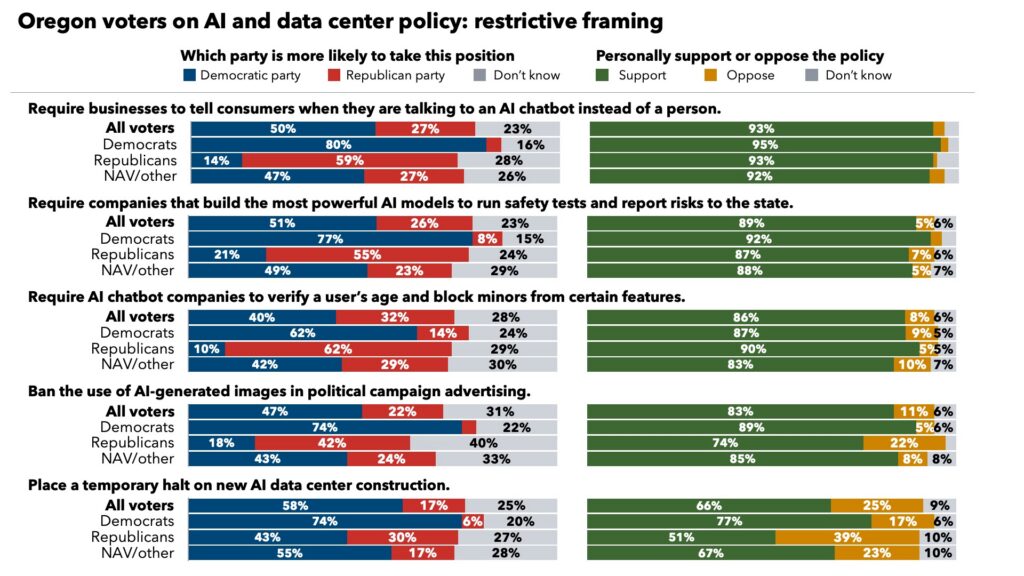
Oregonians support a range of AI and data center restrictions. But they tend to think only their political party shares their views.
Oregonians support all five of the restrictive policies that we tested, including placing a temporary halt on new data center construction (66%). There is also near-universal support for AI regulations such as requiring companies to inform consumers when they are talking to a chatbot rather than a person (93%) and requiring AI chatbot companies to verify a user’s age and block minors from certain features (86%).
Notably, while large majorities of Democrats, Republicans, and non-affiliated voters supported these restrictive policies, they tended to think only their own party shared their view. For instance, 89% of Democrats and 74% of Republicans support a policy to ban the use of AI-generated images in political campaign advertising. However, when asked which political party is more likely to take this position, 74% of Democratic voters said the Democratic Party takes this position, while only 18% of Republican voters said it is a Democratic Party position. The mirror image holds on age verification. 62% of Democratic voters say requiring AI chatbot companies to verify a user’s age is a Democratic Party position, and 62% of Republican voters say it is a Republican Party position. Identical numbers, opposite conclusions, on a policy that nine in ten voters in both parties support.
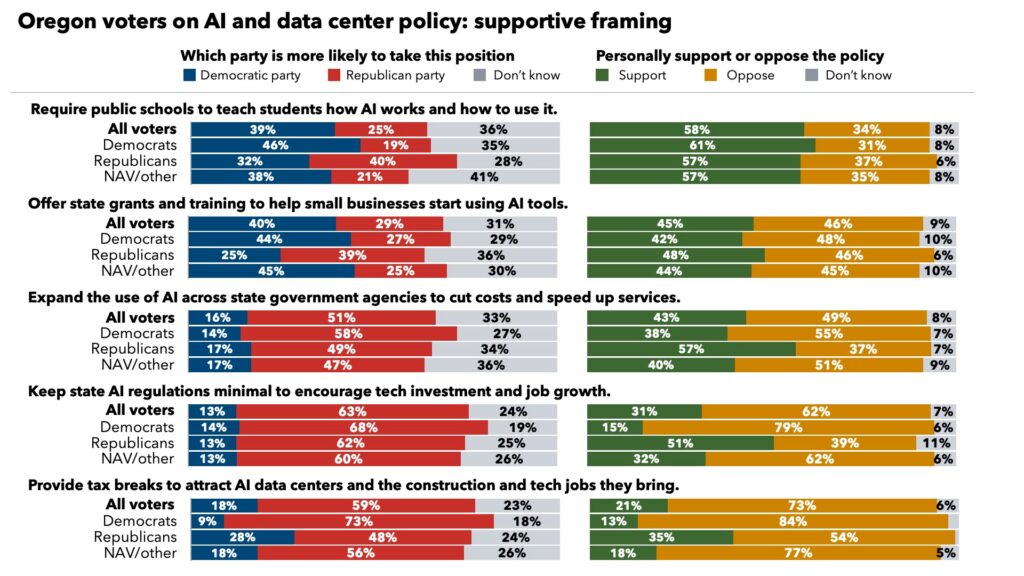
Oregonians are ambivalent about some supportive AI policies, but overwhelmingly oppose tax breaks for data centers.
Despite their mostly negative views about AI overall, a modest majority (58%) of Oregonians support requiring public schools to teach students how AI works and how to use it. Oregonians are split on policies to offer state grants and training to help small businesses start using AI tools (45%) and to expand the use of AI across state government agencies to cut costs and speed up services (43%).
What voters of all political stripes oppose is providing tax breaks to attract AI data centers and the construction and tech jobs they bring. Only 21% of all voters support this and 73% oppose it, ranging from just 13% of Democrats to 35% of Republicans. This is also the policy Oregonians most clearly read as partisan: 59% say tax breaks are a Republican Party position.
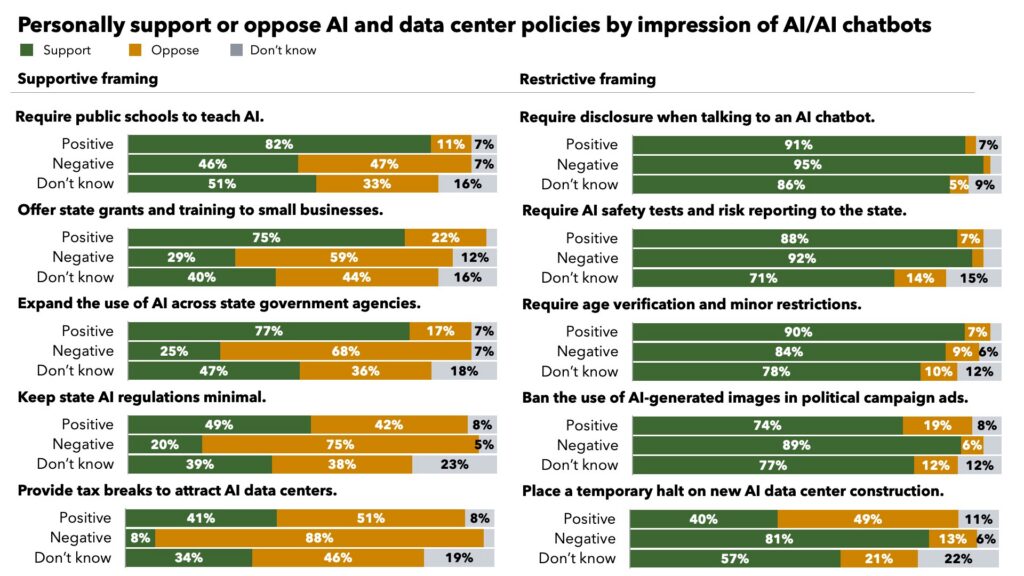
Oregonians who have a positive impression of AI are much more likely to favor the supportive policies, but they want the same restrictions as everyone else.
Those who have a positive impression of AI (generally and AI chatbots) are much more supportive of policies to require schools to teach students how AI works and how to use it (82%), offer state grants and training to help small businesses start using AI tools (75%), and expand the use of AI across state government agencies to cut costs and speed up services (77%).
Opinions about AI are also strongly related to views on data centers. 81% of Oregonians with a negative opinion about AI support placing a temporary halt on new data center construction compared to 40% of those who feel positive about AI. Likewise, only 8% of those with a negative opinion about AI support providing tax breaks for data centers versus 41% of those with positive AI impressions.
Oregonians are skeptical of AI and want to pause data center construction. Yet there are signals that they expect AI to stay and want society to prepare and adapt.
Most Oregonians hold a negative view of AI and data centers. They support a temporary halt on new data center construction and oppose tax breaks to encourage data center development. However, perhaps with the longer view in mind, a majority of Oregonians want schools to teach students about AI and how it works. And a significant share of Oregonians are open to the state helping small businesses use AI and incorporating AI into state agencies.
The politics of AI and data centers are unsettled. Oregonians hold conflicting notions about where the Democratic and Republican parties stand on the issue. Given the economic and social stakes, this is a moment of opportunity and risk for Oregon’s political leaders.
About the Survey
DHM Research conducted the July 2026 Oregon Pulse among 600 Oregon voters from July 23 to 28, 2026. The margin of error for the full sample is ±4.0%.