
In late 2025, DHM asked Washington residents about their thoughts on AI, data centers, energy affordability and reliability, and nuclear energy. These topics are up for discussion in the current Washington legislative session. Lawmakers are hearing and making policy recommendations based on a preliminary report analyzing the economic and environmental impacts of data centers from the data center workgroup, established by Governor Ferguson through an executive order. The rapidly increasing use of AI requires more energy to power data centers, and more data centers in general. To address concerns about rising energy costs and demand, some lawmakers are considering charging data centers higher energy rates or expanding nuclear energy use through new technologies such as small modular reactors. Overall, what do Washingtonians think about these topics, and how do opinions change by region? Read on to find out.
AI & Data Centers
Before asking Washingtonians about data centers, we got a pulse on their perceptions of AI’s impact on society and found their opinions split, though leaning negative. 45% of Washington residents believe AI’s impact on society is positive, with 50% believing it to be negative, and 5% unsure.
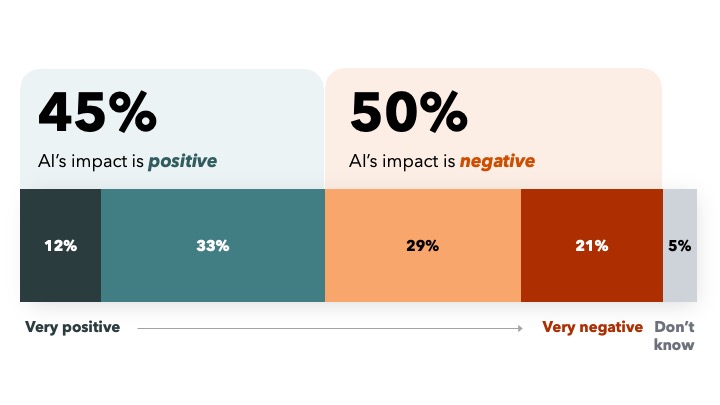
King County residents are more likely to see AI’s impact on society as positive than those in other areas of the state, especially Puget Sound and Western Washington (60% positive in King County vs. 36% in Puget Sound, 37% in Western Washington, and 47% in Central/Eastern Washington[1]). Additional demographic groups of Washingtonians who are more likely to see AI’s societal impact as positive than their subgroup counterparts include those ages 30-44, men, Hispanic/Latinx, college-educated, employed full-time, and Republicans (54% – 62% positive; see crosstabs below for exact data points).
Survey respondents were then given the following context before answering questions about data centers: Data centers are specialized facilities where computers and IT equipment are used to process, store, and manage large amounts of data. These facilities are essential for running services like artificial intelligence and many online applications, such as streaming, internet searching, or social media use. Data centers require a large amount of electricity, both to power all the equipment and to keep the systems cool and prevent them from overheating.
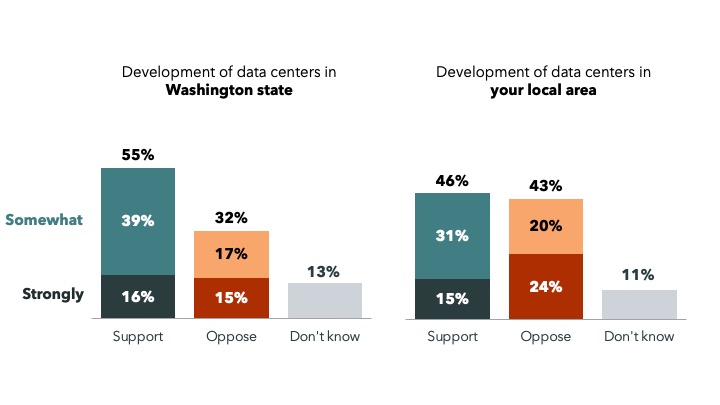
We found that just over half of Washingtonians support the development of data centers in their state (55%). However, less than half support a data center being built in their own local area (46% support, 43% oppose).
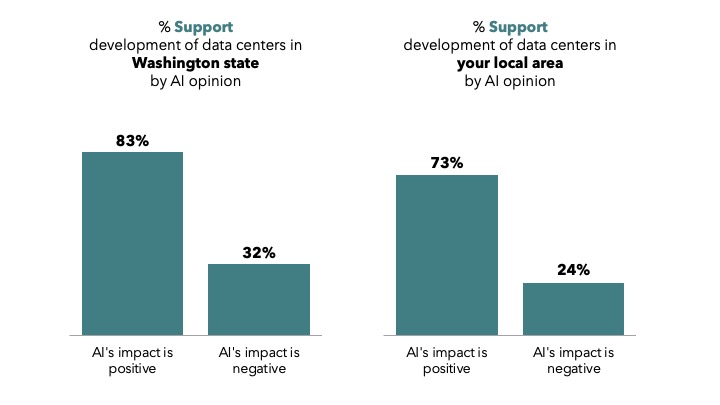
In general, those who view AI’s impact as positive are more likely to support data center development statewide and at the local level.
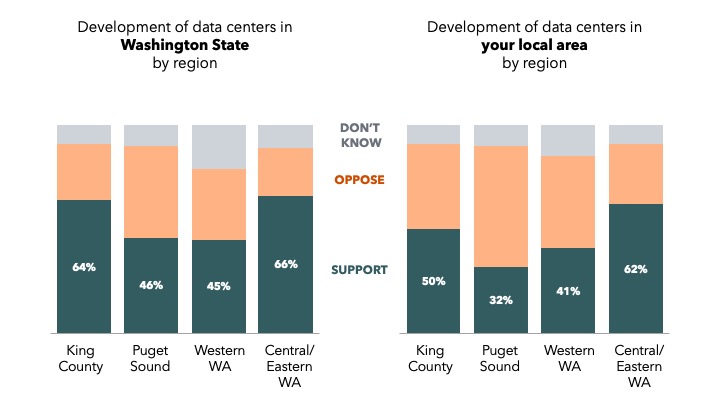
Regional opinions on the construction of new data centers will be important to lawmakers in the coming year(s). We find that residents in King County and Central/Eastern Washington—areas where most data centers in the state are located—are most supportive of data center development in Washington state. Central/Eastern Washington residents are also most supportive of data center development in their local area compared to those in all other areas of the state. Meanwhile, Puget Sound residents are more likely to oppose data center development, especially in their local area, while Western Washington residents have more mixed opinions or are unsure.
54% of Washingtonians feel that data centers should be charged more for electricity compared to households and other businesses in Washington.

This suggests that statewide opinion aligns with two bills about data centers up for discussion in the January 2026 state legislative session. Support varies by region, however. King County and Puget Sound residents are more likely to feel that data centers should be charged more (61% – 62%), while Central/Eastern and Western WA residents are relatively split between charging data centers more (46% – 47%, respectively) or the same amount (35% – 37%). Those who think AI has a negative impact on society are also more likely to think data centers should be charged more (60%), but even 50% of those who feel positively about AI’s impact agree.
Rising Energy Costs & Demand
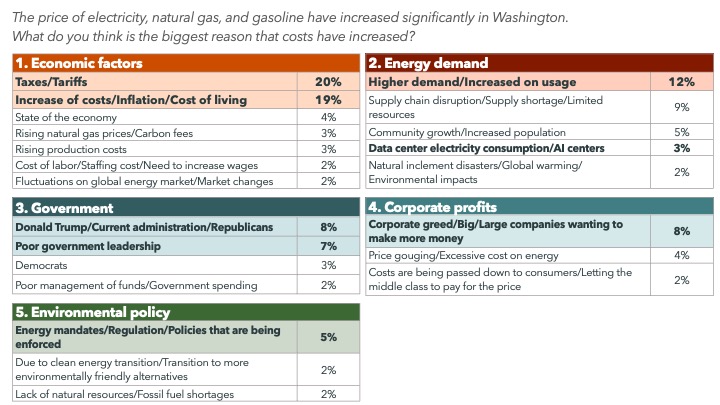
Washingtonians identify five major themes when asked open-ended what they think is the biggest reason energy prices have increased in the state, listed in order of strength: taxes/economic factors, increased energy demand, current government leadership, corporate profits, and environmental policies. Notably, only 3% mention data center electricity consumption/AI.
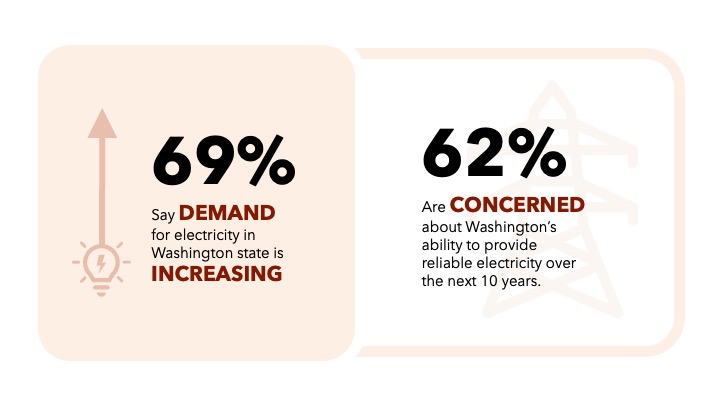
When asked directly, nearly 7 in 10 Washington residents think that the demand for electricity in the state is increasing. Subsequent concerns about reliability follow: 62% of Washington residents are concerned about the state’s ability to provide reliable electricity over the next 10 years. These are issues that are unifying across most key demographic groups—even political party—with one exception: Central/Eastern Washington residents[2].
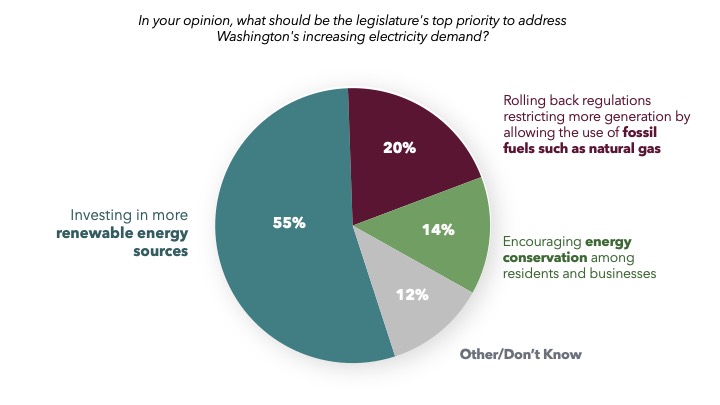
When asked what the state legislature’s top priority should be to address Washington’s increasing electricity demand, just over half of residents agree it should be investing in more renewable energy sources. One in five are of the opinion that legislature should focus on rolling back regulations to allow the use of fossil fuels, such as natural gas, to generate more energy. Putting the onus on individual residents and businesses is the least popular choice.
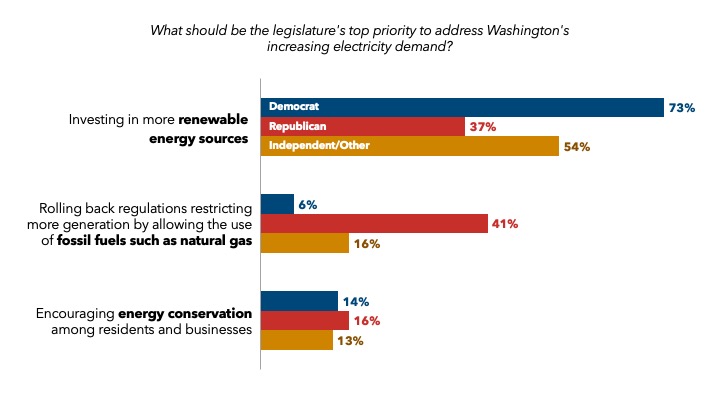
The opinion that legislature should prioritize investments in renewable energy sources over regulation rollbacks that favor fossil fuels is consistent among Washingtonians across most key demographic groups, with the exception of political party. Republicans are more likely to support rolling back regulations in service of generating more energy from fossil fuels than to support investments in renewable energy.
Nuclear Power & Technology
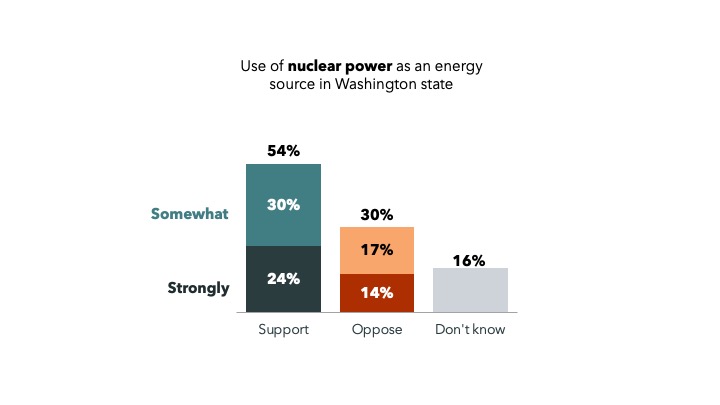
Per the Clean Energy Transformation Act (CETA) passed in 2019, utilities in Washington must provide 100% renewable or non-emitting electricity by 2045. As renewable energy sources are stretched to their limits, policymakers and tech companies are looking to a non-emitting electricity source: nuclear energy. Over half (54%) of Washingtonians support the use of nuclear power as an energy source in the state.
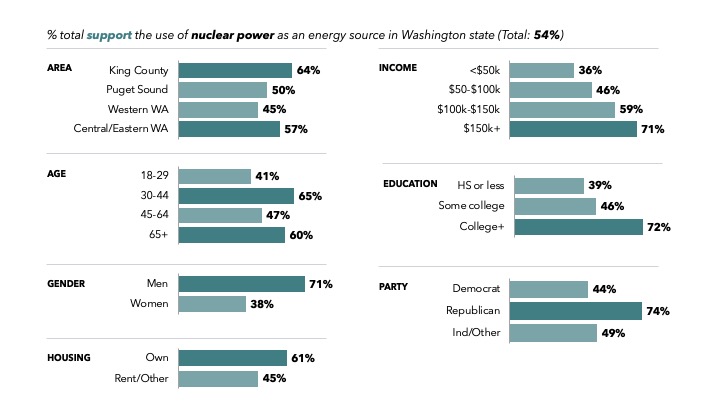
Support is even stronger among King County and Central/Eastern WA residents, those ages 30-44 or 65+, men, those with higher income levels ($100K+), those with higher education levels (college degree or more), Republicans, and homeowners. Most residents with lower levels of support are split between opposition and uncertainty about nuclear energy.
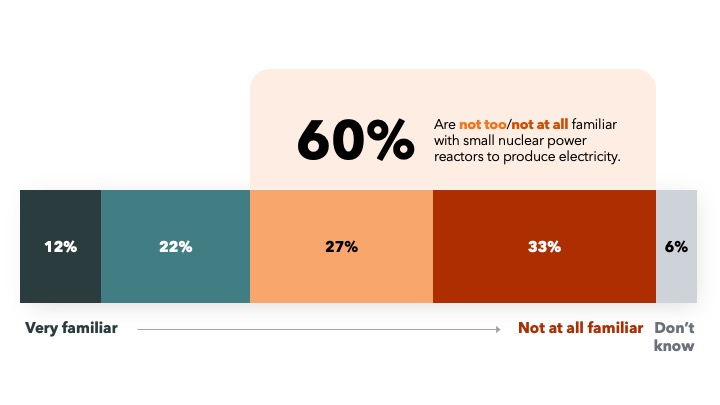
Though they support the use of nuclear energy, Washingtonians are not familiar with small modular nuclear reactors (SMRs), a new technology for generating nuclear energy that will likely begin construction in WA within the next 5 years and across the country within the next 15 years. 60% say they are not familiar with small modular nuclear power reactors used to produce electricity.
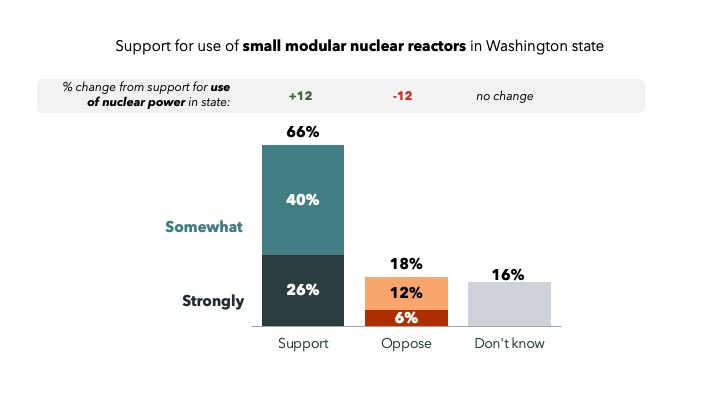
When provided with information about SMRs[3], nearly 2 in 3 Washingtonians support their use in the state. Interestingly, uncertainty aligns with previously expressed views on nuclear power, but opposition shifts to support when focusing on SMRs. This pattern holds across demographic groups: 51% to 85% support the use of SMRs, while general support for nuclear power ranges from 36% to 74%. This suggests that learning more about how nuclear energy is generated could increase Washingtonians’ support for its use in the state.
The opinions of Puget Sound and Western Washington residents may be worth watching as these issues progress and development projects are introduced, considering they are more likely to see AI’s impact as negative, are less supportive of data center development, and are less likely to support nuclear energy as a power source in Washington without more information.
Footnotes
[1] Regions are defined by county:
- King County
- Puget Sound: Clallam, Island, Jefferson, Kitsap, San Juan, Skagit, Snohomish, Whatcom
- Western Washington: Clark, Cowlitz, Grays Harbor, Klickitat, Lewis, Mason, Pacific, Pierce, Skamania, Thurston, Wahkiakum
- Central/Eastern Washington: Adams, Asotin, Benton, Chelan, Columbia, Douglas, Ferry, Franklin, Garfield, Grant, Kittitas, Lincoln, Okanogan, Pend Oreille, Spokane, Stevens, Walla Walla, Whitman, Yakima
2 Those in Central/Eastern WA are split on their concern for the future of reliable energy, with 46% not very or not at all concerned, a figure significantly higher than in all other areas of the state. Notably, Central/Eastern WA is home to a higher share of the state’s top energy production centers—including hydropower dams, wind farms, and the state’s only currently functional nuclear power plant—which may contribute to stronger feelings of safety regarding energy reliability.
3 Small modular nuclear power reactors, or SMRs, are designed with modular technology using standardized factory fabrication, making them easier to design, build, and operate than traditional large-scale nuclear power plants. SMRs are typically about one-tenth the size of traditional large-scale nuclear power reactors. SMRs can generate up to 300 megawatts of electricity, equivalent to the power used by 150,000 homes for one year.