
Housing affordability remains one of Oregon’s most pressing challenges, yet there is growing resistance in many communities to exploring local solutions. In recent DHM focus groups and statewide surveys, Oregonians have repeatedly expressed concerns about affordable housing development, primarily regarding safety, neighborhood character, and economic priorities.
Housing affordability is a prominent issue, but there are higher priorities.
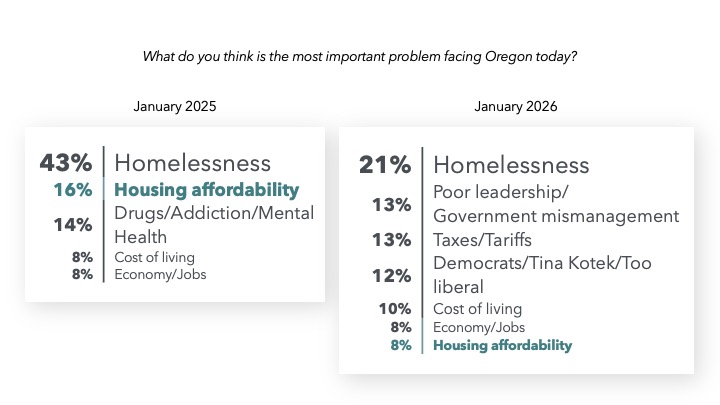
Throughout last year, Oregonians identified housing affordability as the second most important problem facing the state, second only to homelessness. Now, in early 2026, many Oregonians still say housing affordability is the most important issue, with related issues of the economy, cost of living, taxes, and government mismanagement rising in importance. Homelessness remains the top issue. This suggests that, over the past few months, while housing affordability remained on the radar, both homelessness and housing affordability became lower priorities as frustration with the government and economic concerns rose. By extension, many Oregonians may prioritize solutions for middle-income and workforce community members over low-income housing.
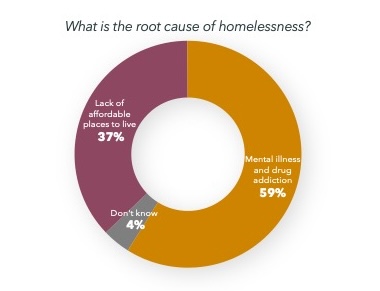
Over the last decade, DHM has asked Oregonians from time to time what they believe is the primary cause of homelessness. Most recently, in 2023, the majority of Oregonians said homelessness is mostly the result of mental illness and drug addiction, compared to less than 4 in 10 who thought it was primarily the result of a lack of affordable places to live (the rest were unsure). This shows that even while many people continue to say that homelessness is Oregon’s most important problem, fewer people prioritize housing affordability as the primary solution.
Many believe that middle-income housing should be a priority, with an emphasis on accessible home ownership over affordable rentals.
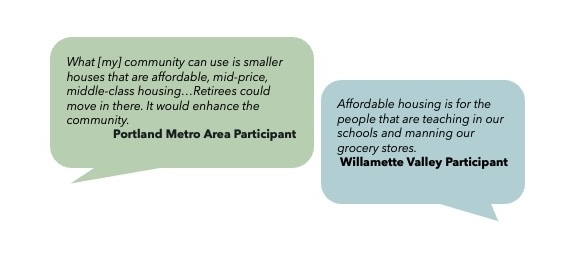
In five recent DHM focus groups, participants expressed a perceived housing gap for middle-income rather than for lower-income households. Specifically, they view households earning $50k-$150k per year as the most overlooked and express a desire for more mid-size and starter homes in their communities. As one focus group participant in the Portland metro area said, “What [my] community can use is smaller houses that are affordable, mid-price, middle-class housing…Retirees could move in there. It would enhance the community.” In a separate focus group in the Willamette Valley, a participant said, “Affordable housing is for the people that are teaching in our schools and manning our grocery stores.”
There is a widespread belief across Oregon communities that homeownership is seen as the primary way to build wealth. There is skepticism about the effectiveness of affordable rental housing in creating financial stability, and a clear preference for homeownership. As one Willamette Valley focus group participant voice, “Generational wealth is by people owning homes, not building more apartments.”
While Oregonians value homeownership and believe there is a current low supply, they are resistant to more homes being built in their neighborhoods.
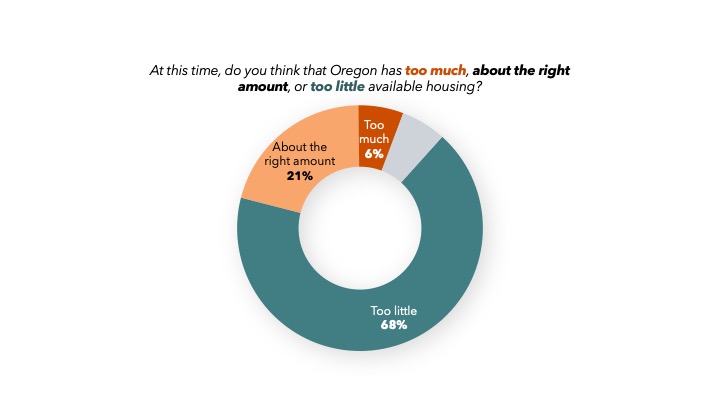
Oregonians are conflicted about adding additional housing. On the one hand, most agree that the state has too little supply. Yet they are equally, or even more, concerned about the impact of additional housing in their neighborhoods. For instance, in recent statewide surveys, when asked to consider the likely impact of building additional housing in their own neighborhoods, Oregonians were more likely to think that would increase rather than decrease rents, while at the same time decreasing rather than increasing their personal satisfaction with their neighborhood.
Many Oregonians believe that affordable housing increases crime.
In recent months, focus group participants have often associated affordable housing with increased crime. In a Willamette Valley focus group, a participant expressed concern that “There is potentially more crime as more people come.” There is a perception that introducing low-income housing will compromise safety, increase theft and vandalism, and erode trust among neighbors. More broadly, affordable housing is seen as incompatible with the cultural and aesthetic values residents cherish about their communities.
Two notable exceptions exist, however, for seniors and individuals who already work in the community. Senior community members are considered a particularly deserving population for affordable rental housing, with participants citing the minimal strain they would add to existing services and schools. Similarly, participants note that the teachers, firefighters, and police officers who serve their communities have a right to affordable housing in the area. There is an implicit understanding that both groups – seniors and public servants – are already members of their communities, and not a threat to public safety or neighborhood character.
Written by: Phoebe Wagner