
Talk to anyone working on key transportation issues and it becomes easy to imagine a future far different than what we have now: one where people are less likely to own their own cars and more likely to rely on shared ride-hailing services, where autonomous cars are common, and where traffic congestion is alleviated in part by air taxis, that is, taking trips a level up above the roads.
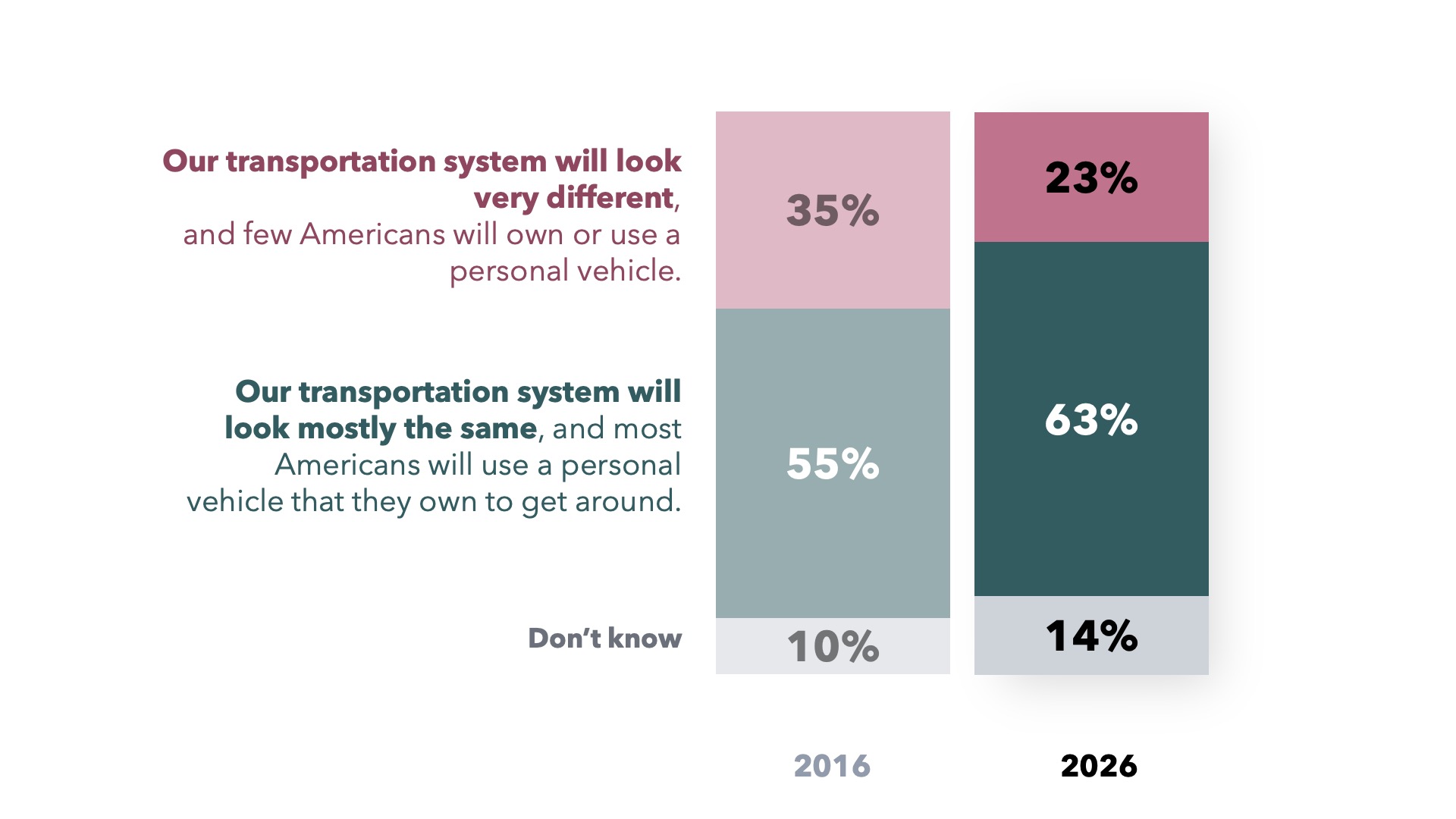
Although in many ways these possibilities are becoming increasingly real, the public appears less confident that major changes will fundamentally shift Americans’ reliance on cars. Back in 2016, DHM asked people across the country what they thought transportation in the U.S. would look like in 20 years: mostly the same, with most Americans using a personal vehicle to get aroundor very different, with few Americans owning or using a personal vehicle to get around. At that time, about one in three (35%) thought transportation would look very different in 20 years.
We recently asked this question again. Interestingly, fewer Americans now anticipate dramatic shifts in transportation: about one in four (23%) expect to see a major difference over the next 20 years, at least in terms of owning and using a personal vehicle to get around.
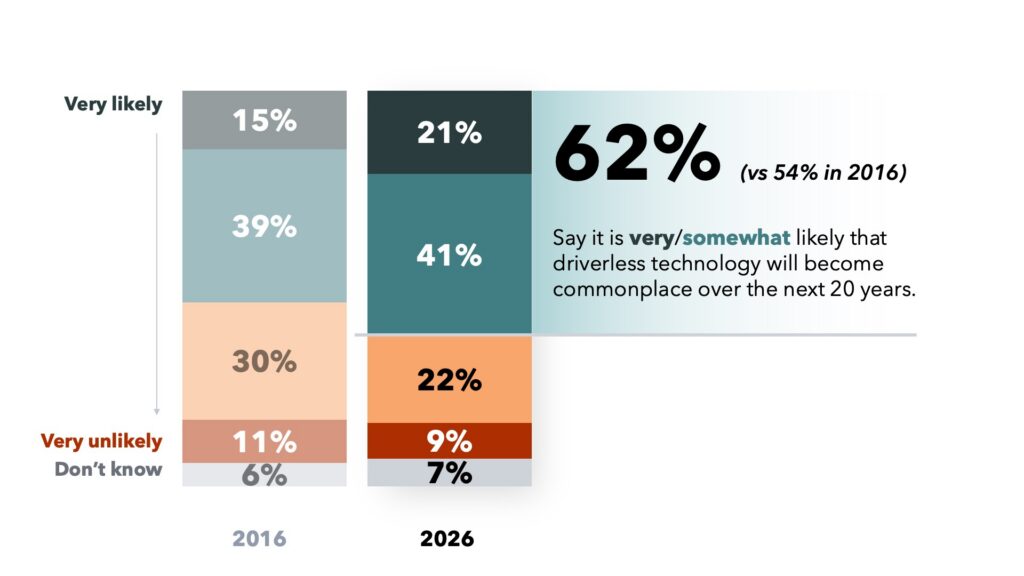
While Americans may not envision giving up their cars, they do anticipate driverless technology to be increasingly common. Back in 2016, about half (54%) of our participants expected driverless technology to become commonplace in the next 20 years, compared to six in ten (62%) now.
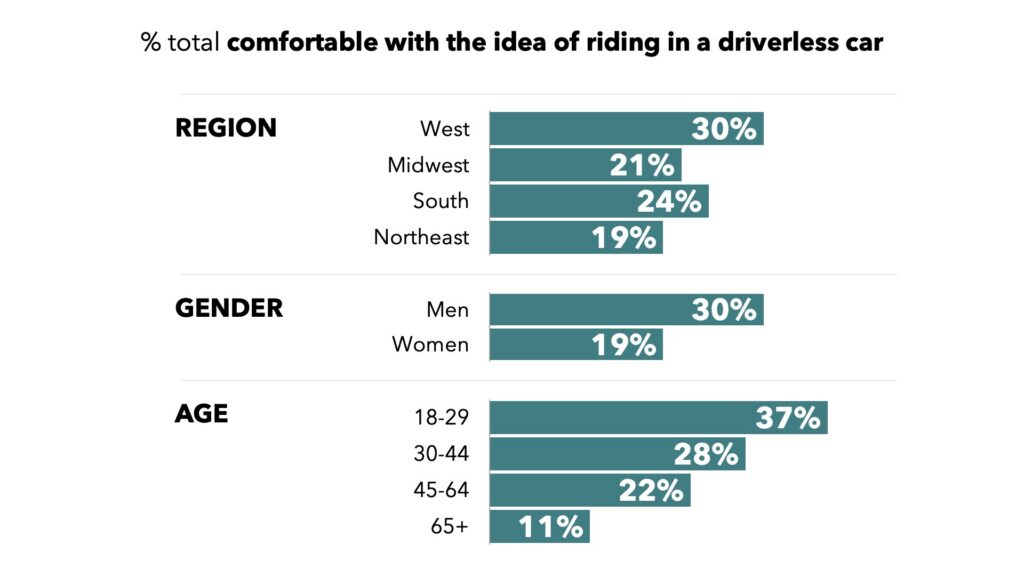
This shift reflects reality. Fully autonomous driverless cars have been deployed in more cities over the past ten years, and 10% of our respondents have ridden in one. Strong hesitation over riding in driverless cars is evident, however: 44% are not at all comfortable doing so, with an additional 30% feeling not too comfortable about riding in one. Americans who live in the western part of the country, men, and younger people are all more comfortable with the idea of riding in a driverless car.
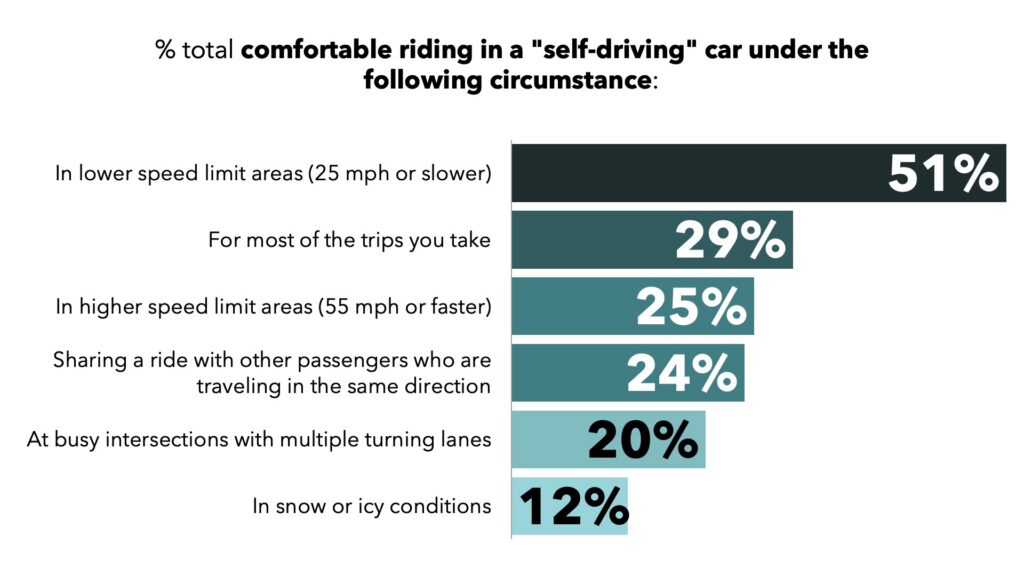
Comfort levels also vary depending on the context: people are most comfortable riding in driverless cars in areas with low speed limits and are least comfortable in snow or icy conditions.
While public readiness may not have quite caught up with the bolder visions of transportation futurists, attitudes will undoubtedly shift as driverless cars move from novelty to neighborhood fixture. We will need to wait and see whether the convenience of on-demand driverless vehicles can overcome Americans’ love of personal vehicles.
Written by: Michelle Neiss
About the Survey
The national survey was conducted by DHM Research April 2—9, 2026, among 666 U.S. adults. Margin of error: ±3.8%. DHM Research is a nonpartisan, independent opinion research firm specializing in research to support public policy making.