
The national mood is grim. Seven in ten Washington residents say the United States is on the wrong track. They describe thinking about the country in words like disappointed, concerned, frustrated, and anxious. By virtually every emotional measure, the national picture feels dark.
And yet, zoom into the block, the neighborhood, the city, and something different emerges.
A new DHM Research survey of 500 Washington residents conducted in March 2026 finds that while pessimism about the nation runs deep, Washingtonians are quietly building something more hopeful closer to home. Their communities, local leaders, sports teams, and neighbors are providing a shield against the turbulence of national politics. The data tell a story not just of despair and concern, but of where people are choosing to anchor themselves when the bigger world feels overwhelming.
The Three-Tier Divide
The survey asked residents whether Washington state, the United States, and their local community were each headed in the right direction or on the wrong track. The results form a striking gradient.
When it comes to the nation, just 25% of Washingtonians say the U.S. is headed in the right direction, with a decisive 70% believing it is on the wrong track. But Washington state fares considerably better: 51% say the state is on the right track.
The real story, though, is at the local level. 57% of Washington residents say their local community is headed in the right direction, the strongest of the three measures, and one that holds across demographic groups.
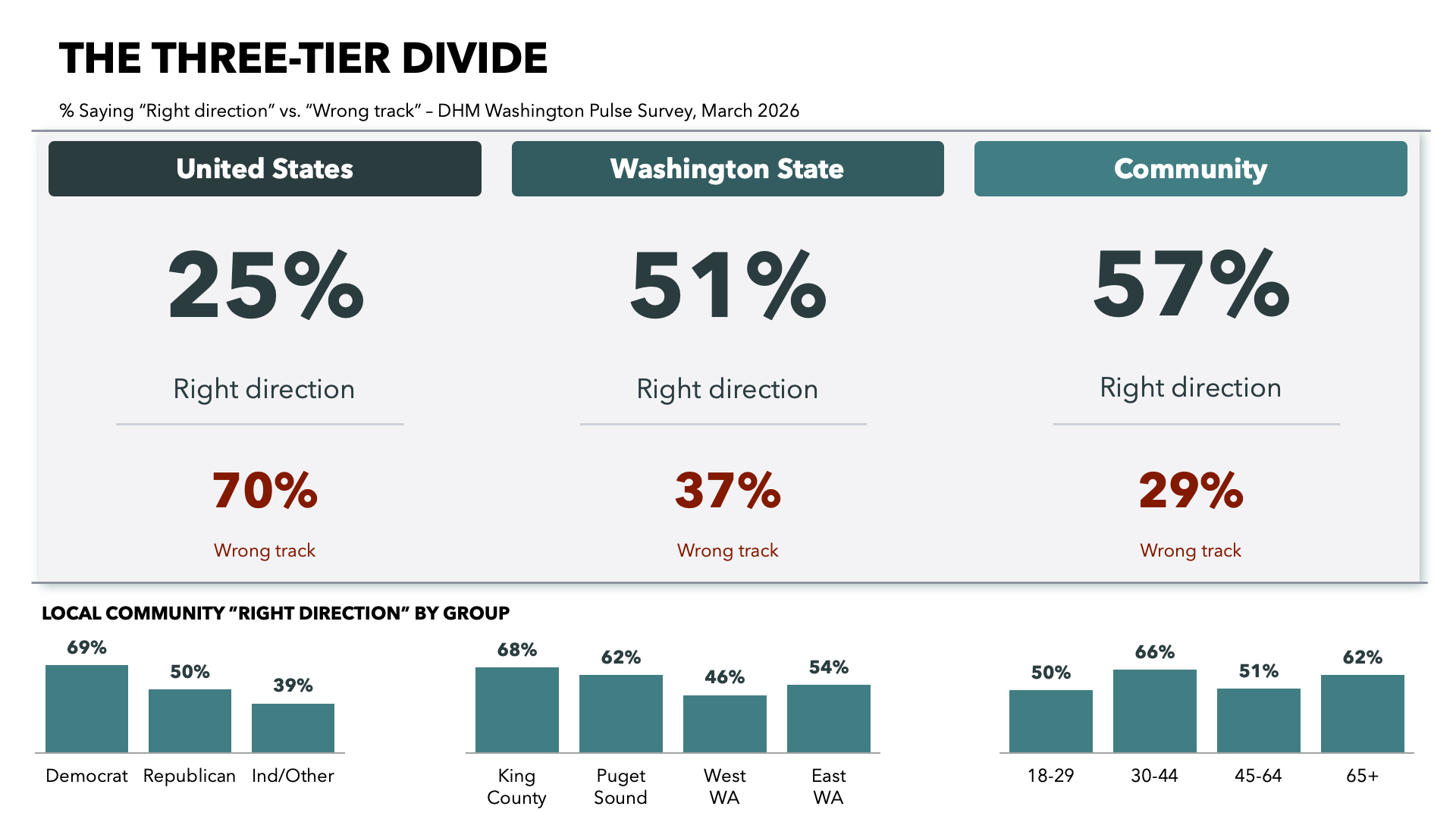
This isn’t simply partisan optimism. Among Democrats, 69% view their local community positively, but so do half of Republicans (50%). Residents in King County (68%) and the Puget Sound region (62%) are especially bullish on their communities, and adults aged 30–44 express the most local confidence of any age group (66%).
Two Different Emotional Worlds
Perhaps the most vivid finding in the survey is the emotional gap between how people feel about the country versus their community.
Asked to select up to three emotions when thinking about the current state of the United States, respondents overwhelmingly chose negative words: 46% feel disappointed, 44% feel concerned, 41% feel frustrated, and 33% feel anxious. Only 17% felt hopeful about the nation, and just 11% felt proud.
Flip the question to the local community, and the emotional palette shifts entirely. Hopeful becomes the top response at 41%. Satisfied (33%), confident (22%), and proud (21%) all outpace their national counterparts by wide margins. Anger drops from 30% nationally to just 6% locally. Overwhelm falls from 18% to 8%.
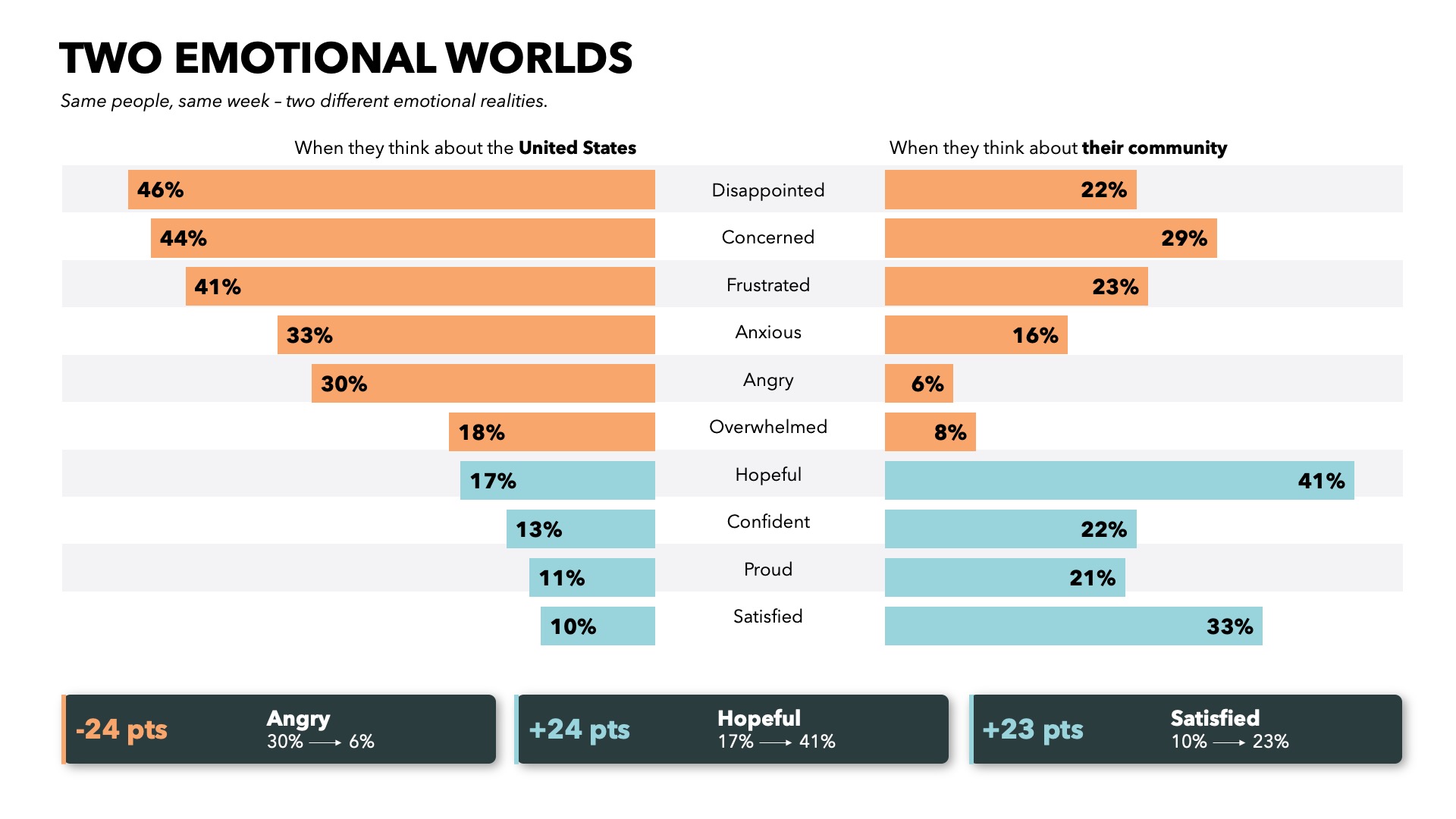
This is not a portrait of a population in denial. The same people who feel disappointed by Washington D.C. feel hopeful about their Washington neighborhood. They’re not tuning out, they’re turning toward local comfort.
Trust Flows Closer to Home
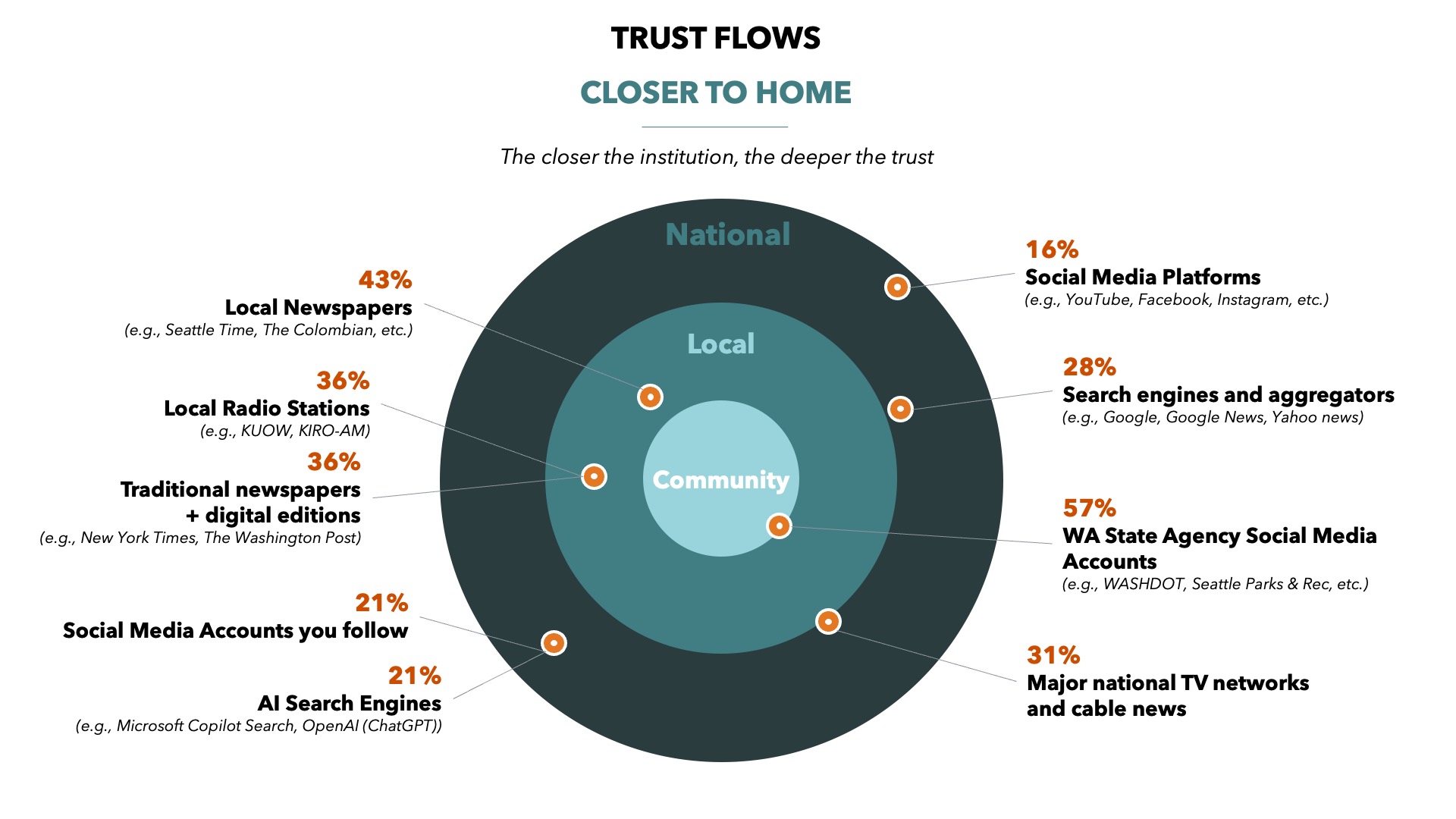
The data on institutional trust reinforce the same pattern. Washington residents consistently rate local outlets above national ones: 43% trust local newspapers, compared to just 31% for major national TV networks. Washington State agency social media accounts are trusted by 57% of residents, far outpacing every other media category measured.
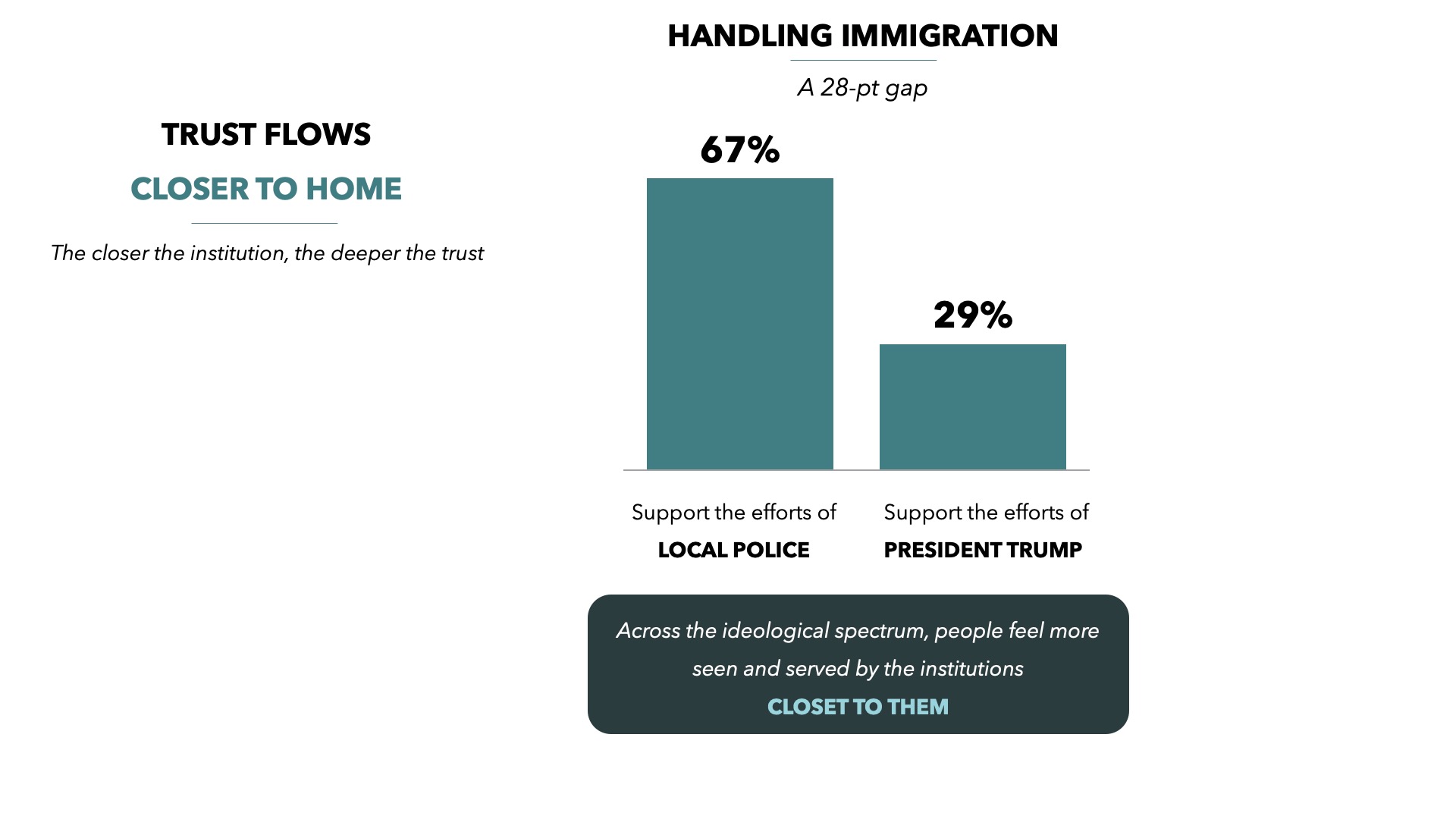
The same holds for political leadership. On immigration, perhaps the most charged issue in the current political landscape, just 29% support how President Trump has handled the issue. That climbs to 50% for Governor Ferguson, 53% for local elected politicians, and 67% for local police. Across the ideological spectrum, people feel more seen and served by the institutions closest to them.
Community as a Coping Mechanism
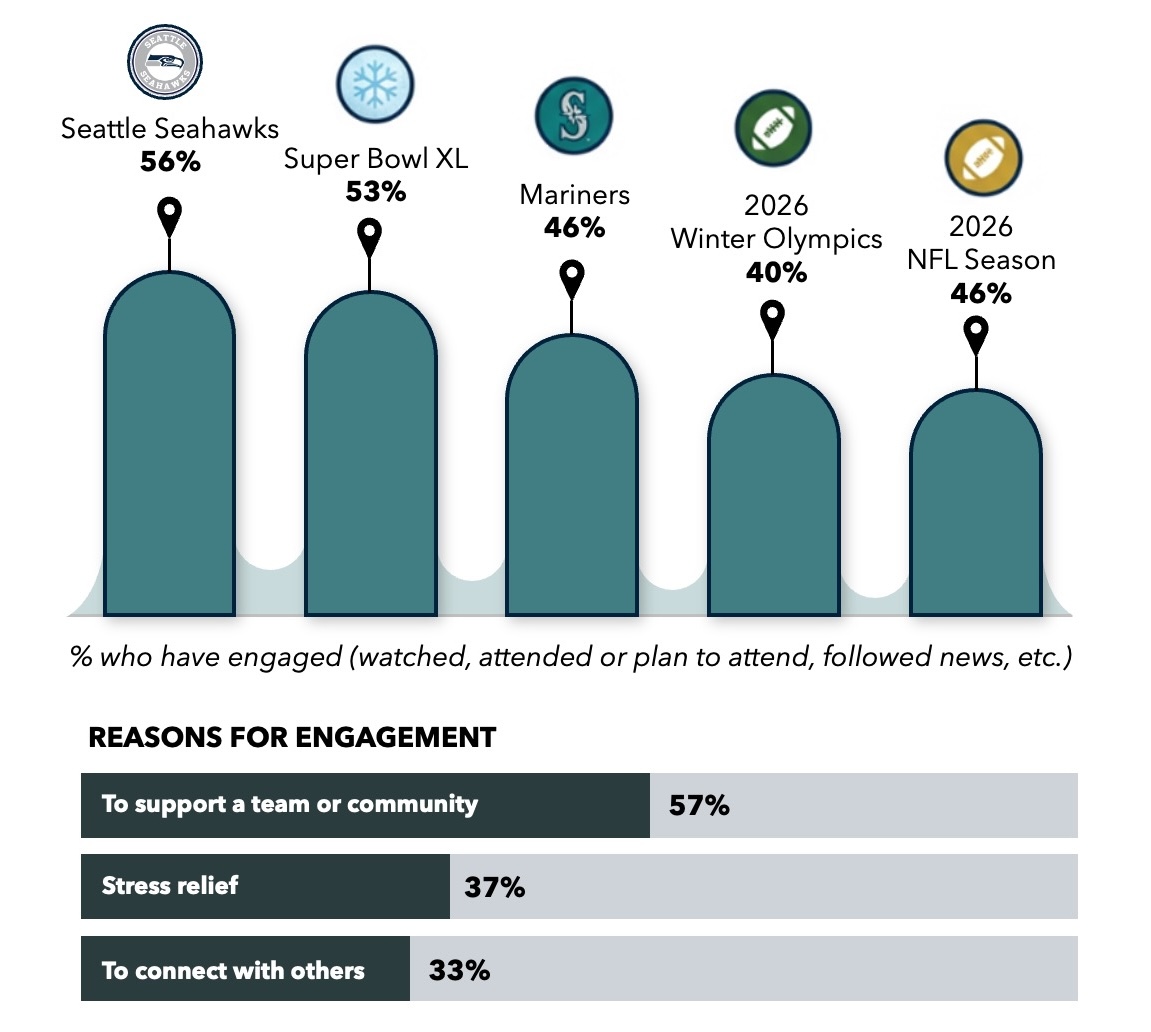
The survey also explored what draws people to shared cultural experiences. Of the 81% who engage with sports or cultural events, 56% say they do so to support a team, creator, or community, and 33% do it specifically to feel connected with others. Stress relief ranks highly too (37%), a candid acknowledgment that shared rituals help people decompress.
When asked what impact these shared moments have on their community, 78% say the effect is positive (40% say very positive). Sports and cultural events, in this data, aren’t just pastimes. They’re civic infrastructure.
The Seattle Seahawks (56%) and the Super Bowl (53%) lead engagement, followed by the Mariners, the Winter Olympics, and the upcoming NFL season. Washingtonians are watching, attending, and following together, and they believe it matters.
The Weight of Real Problems – and How People Hold Them
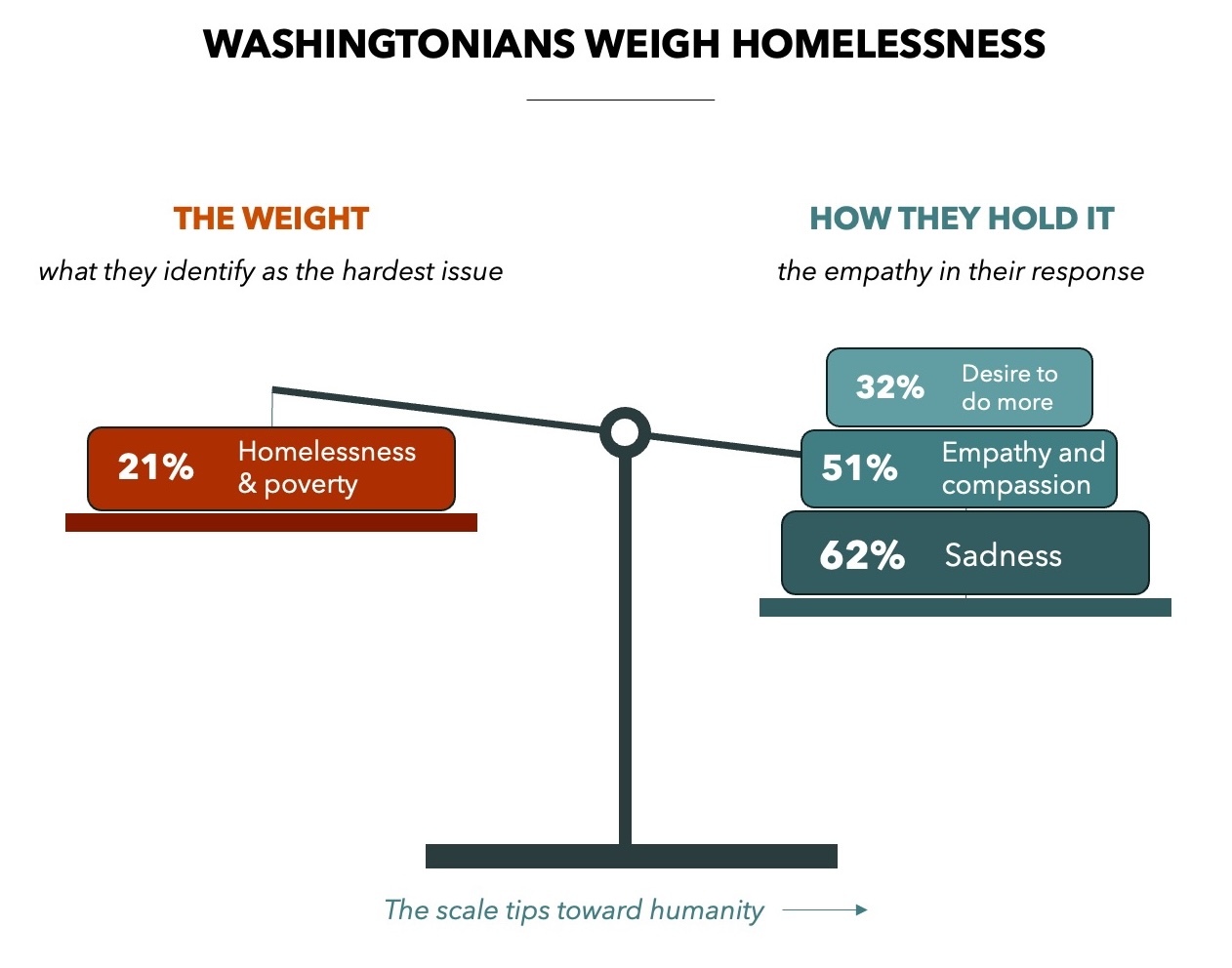
None of this means Washington residents are ignoring difficult realities. The top problems they identify are pressing, homelessness and poverty (21%), cost of living and inflation (20%), and taxes and tariffs (18%). More than half (52%) say public safety in their area has stayed the same over the past year, and a third say it has gotten worse.
But even here, the emotional response is shaped by empathy. When asked how they feel upon encountering someone experiencing homelessness, something 70% of residents do at least weekly, 62% report sadness about homelessness as an issue, and 51% feel empathy or compassion. Only 14% feel frustrated or annoyed. A majority (56%) say the response to homelessness needs more compassion, not less.
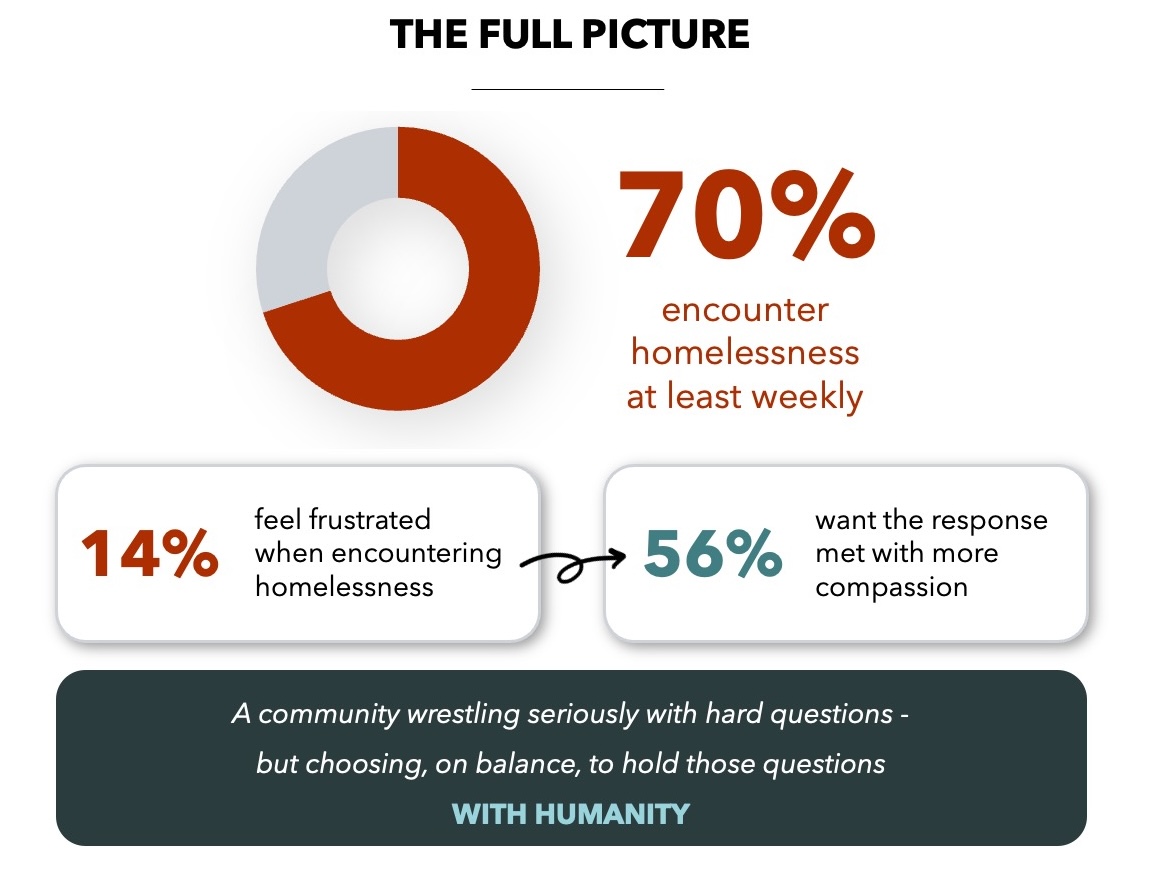
Washington is a community wrestling seriously with hard questions, but choosing, on balance, to hold those questions with humanity.
What the Data Tell Us
The March 2026 DHM Washington Pulse survey captures a moment of genuine tension: a population that is clear-eyed about national dysfunction but not prepared to give up on the places and people nearest to them. The pessimism is real, but so is the local investment.
What emerges is a picture of Washingtonians doing what communities have always done under pressure: drawing inward. Not in retreat, but in renewal. They’re trusting their local paper over cable news. They’re rooting for the Seahawks together. They’re calling their neighborhood hopeful even when they call the country disappointing.
In a data landscape full of alarms, that granular, local hope is worth paying close attention to.
Written by: Jenn Hoker
About the Survey
Data from DHM Research’s Washington Pulse Survey, conducted March 17–25, 2026, among N=500 Washington residents (margin of error ±4.4%).