
This November, Washingtonians will have the chance to weigh in on the state’s new income tax, commonly referred to as the “millionaire’s tax.” The ballot will include Initiative 645, which would repeal the 9.9% income tax on income over $1 million that the Legislature passed in March of this year and prohibit future state and local income taxes. A “yes” vote on Initiative 645 would repeal the income tax, and a “no” vote would keep it in place. However, the ballot language has been the subject of controversy in the lead-up to the election. State law requires the ballot to include a statement from the Attorney General’s office describing how the measure would affect state funding. For Initiative 645, the statement notes that the repeal would decrease funding for public education and human services. The statement has been contested in court, but it will remain on the ballot after the Washington Supreme Court split 4-4 on a challenge in September.
DHM’s September 2026 survey of 800 Washington residents shows that the funding statement makes a measurable difference in how residents say they would vote. To test its impact, half of the respondents saw the ballot language with the statement and half saw it without.
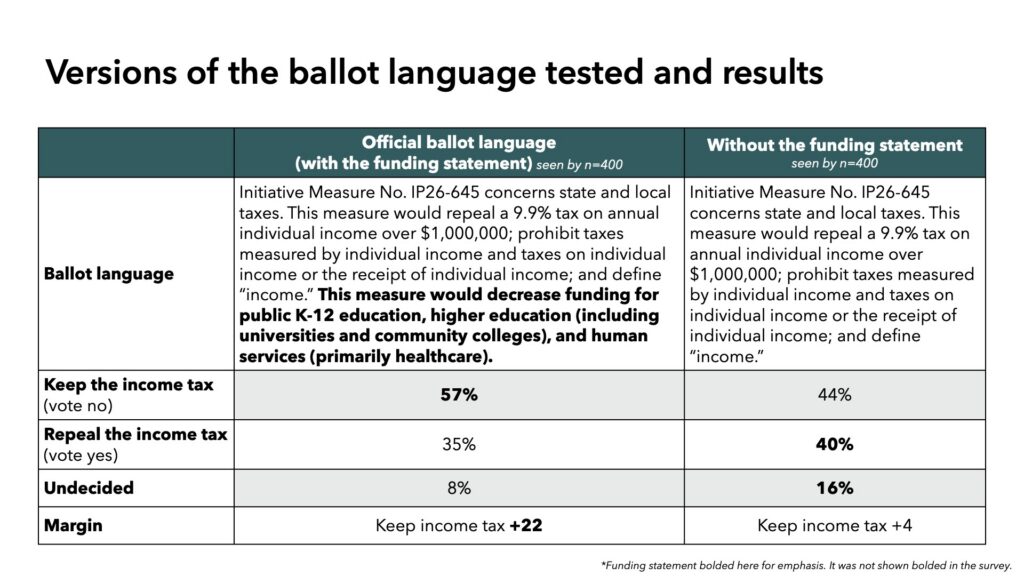
Keeping the income tax leads by 22 points with the funding statement and by 4 points without it
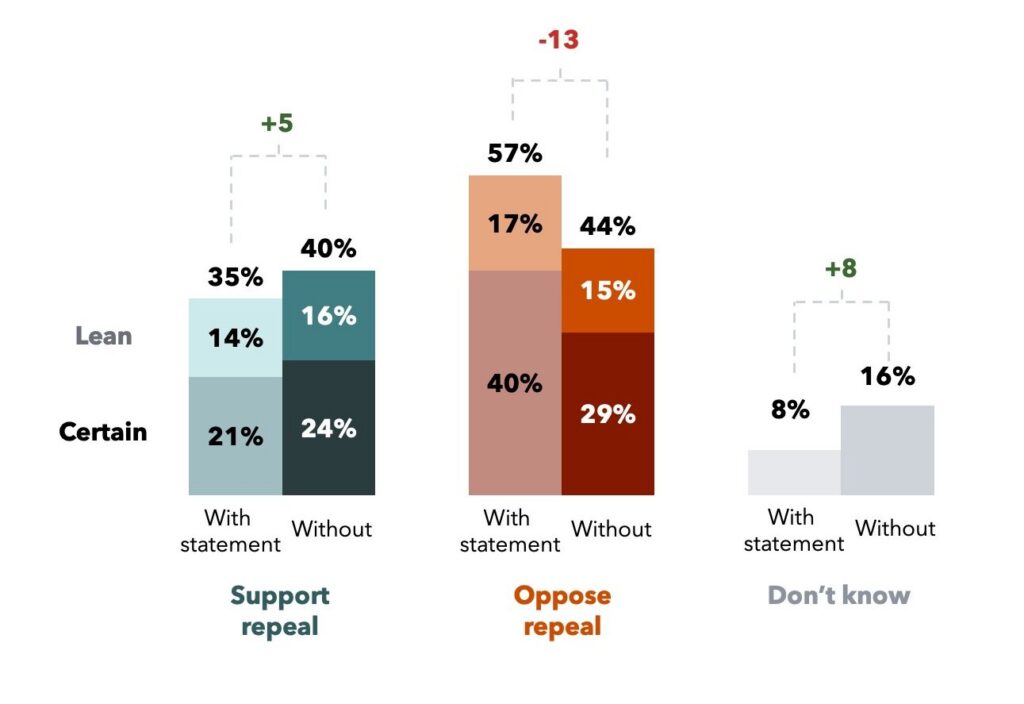
Among residents who saw the official ballot language, including the funding statement, 57% say they would vote to keep the income tax, and 35% say they would vote to repeal it. Forty percent are certain they would keep the income tax, compared with 21% who are certain they would repeal it. These results are consistent with DHM’s November 2025 survey, in which 61% of Washingtonians supported a 9.9% income tax on income over $1 million.
Without the funding statement, the results are closer. Forty-four percent would vote to keep the income tax and 40% would vote to repeal it. The share who are certain of their vote is also similar on each side: 29% are certain they would keep the income tax and 24% are certain they would repeal it.
Support for repeal, and the certainty of those who favor it, is similar in both versions. Support for keeping the income tax, however, is 13 points higher among residents who saw the funding statement (57%) than among those who did not (44%). Much of this difference reflects a larger share of undecided residents among those who did not see the statement (16%, compared with 8% of those who saw it). When asked why they support or oppose the repeal, residents who would keep the income tax were far more likely to cite protecting school funding if they saw the statement than if they did not (44% vs. 2%).
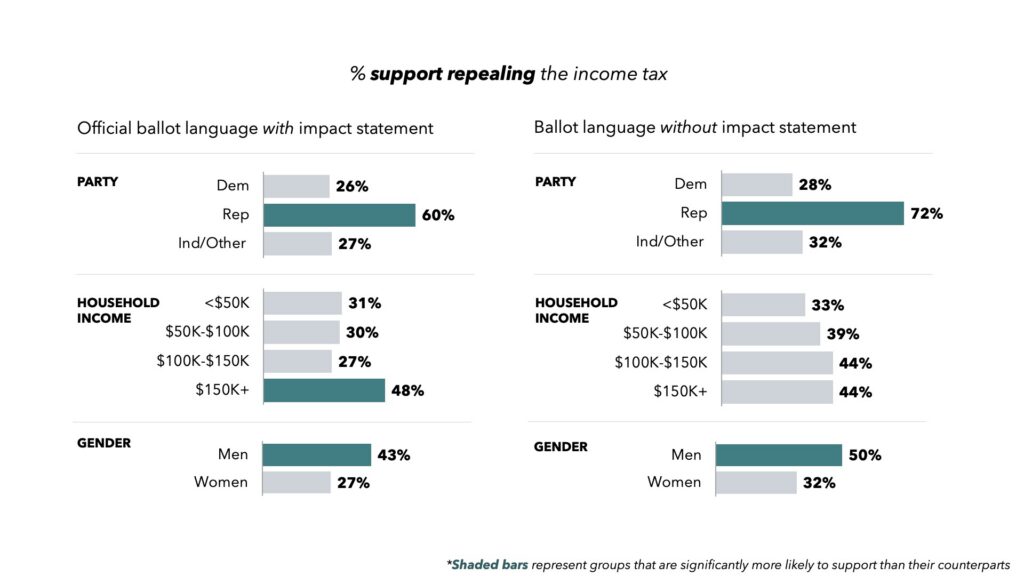
Party affiliation divides residents in both versions, while income differences appear only with the funding statement
In both versions, Republicans are more likely than Democrats and Independents to vote to repeal the income tax. Additionally, men are also more likely than women to vote to repeal the income tax, regardless of the ballot language they saw.
Income differences appear only among residents who saw the funding statement. In that version, residents in households earning $150,000 or more are more likely than all other income groups to vote to repeal the income tax. Among those who did not see the funding statement, support for repeal is similar across income groups.
Support for keeping the income tax does not fully extend to an expanded income tax
We also asked all respondents whether they would support a tax on income over $1 million if the state could later expand it to those earning $100,000 or more. Forty-one percent support it, and 46% oppose it. Opposition rises with household income and is higher among homeowners, men, and residents ages 30 and older.
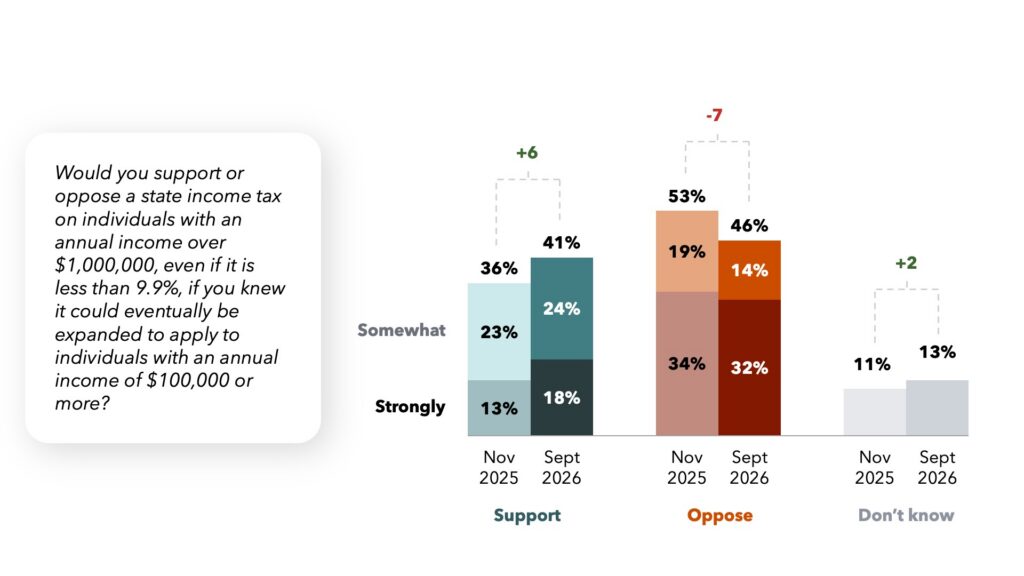
Overall opposition to a potential expanded tax has declined from 53% in November 2025 to 46% in September 2026. The largest change is among Democrats, whose opposition dropped from 56% to 37%. Opposition among Republicans grew from 59% to 67%.
Results differ depending on how the ballot describes Initiative 645
These results are a snapshot of how Washington residents are thinking about Initiative 645, not a prediction of the election outcome. As the measure will appear on the ballot, a majority of residents would vote to keep the income tax. At the same time, the results indicate that the contested funding statement affects how residents say they would vote, particularly among those who would otherwise be undecided. Residents also distinguish between taxing the state’s highest earners and a broader income tax, which suggests the question of income taxes in Washington may continue beyond this November’s election.
Written by: Kara Krnacik
About the Survey
This survey was conducted by DHM Research from September 14 – 21, 2026 among 800 Washington residents. Margin of error: +/-3.5%. DHM Research is a nonpartisan, independent opinion research firm specializing in research to support public policy making.