
Homelessness has dominated Washington headlines for the past two years: encampment sweeps following the U.S. Supreme Court’s Grants Pass ruling, a funding scandal that gutted the region’s largest homelessness authority, and dueling “Housing First” versus “Treatment First” philosophies competing for the same news cycle. The public is often grouped into two camps — compassionate or fed up. Our March 2026 Washington Pulse survey of 500 residents suggests that, while homelessness is considered a top issue among Washingtonians, there is real, measurable common ground in opinions about how the state should move forward.
Homelessness is a local issue
When asked unprompted what they think is the most important problem facing Washington, residents name homelessness and poverty more than any other issue—a pattern that has remained consistent over the past few years. Also toward the top of the list, we see other issues mentioned in conjunction with homelessness that give us more context into why Washingtonians see it as such a big issue, namely housing affordability, drug use or addiction, and public safety. There does seem to be an impending shift, however, with cost of living and inflation poised to take over the top issue spot. This is an area that DHM will be tracking closely in upcoming pulse surveys.
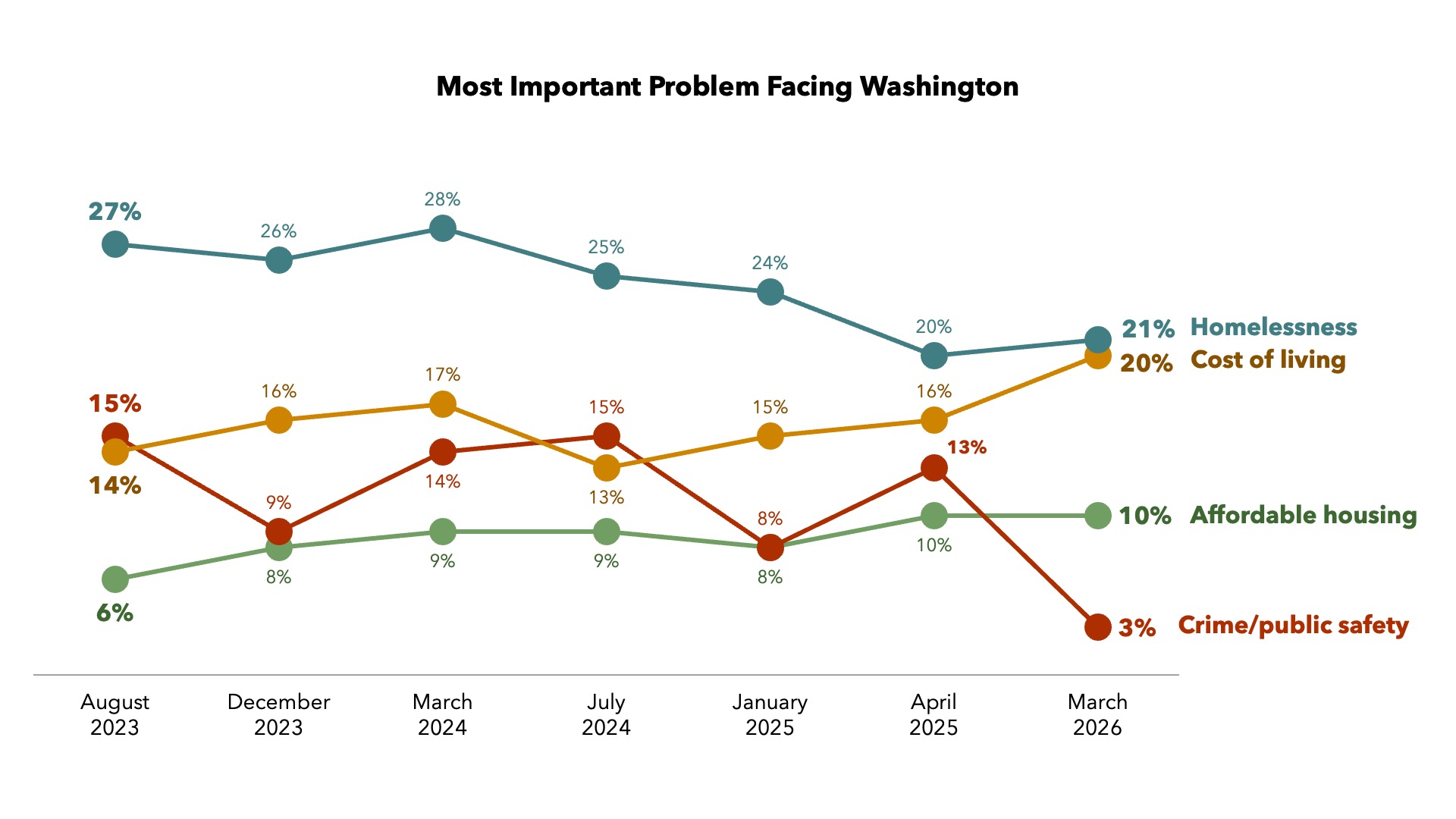
Regardless, the magnitude of this issue to Washingtonians is a striking contrast with where homelessness sits on a national scale. According to recent Gallup polling on the most important problem facing the country today, an average of 4% of Americans name poverty, hunger, or homelessness as the nation’s top problem — a fraction of what we see in Washington (21%). This is considered a local issue far more than one of national concern, especially in King County (27% vs. 15%-22% in other areas of the state). Notably, there are no significant differences by political party or ideology in considering homelessness and poverty as top problems — a point of bipartisan agreement.
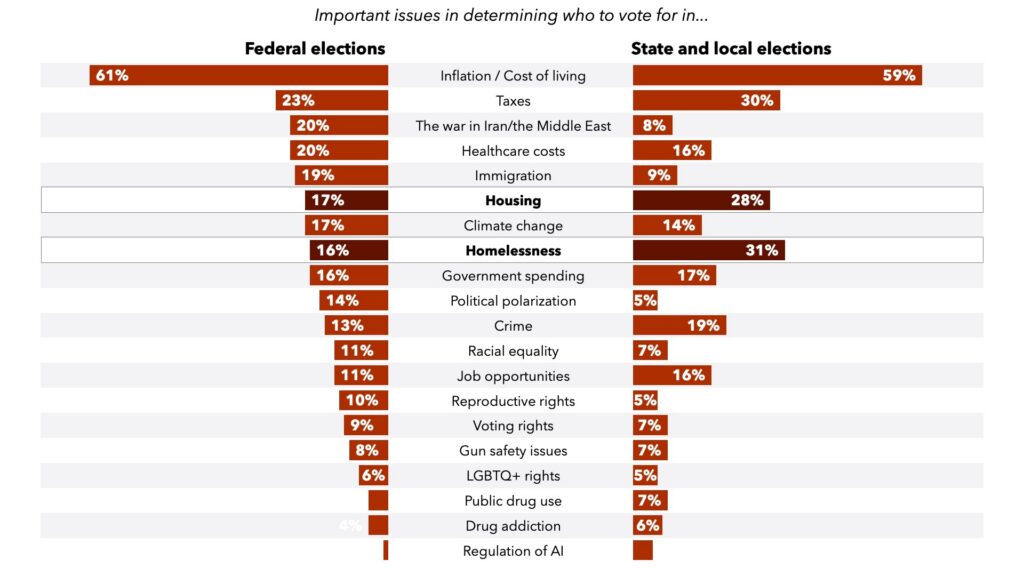
We see the same local-versus-national split when we ask what issues matter most in deciding who to vote for. At the federal level, homelessness (16%) and housing (17%) are mid-tier concerns for Washingtonians, well behind the most motivating issues of inflation (61%) and taxes (23%) — in line with how important these issues rank nationally per the Gallup poll. When we shift the question to state and local elections, homelessness and housing jump to the second- and fourth-most important issues overall (31% and 28%), trailing only inflation (59%) and taxes (30%). In other words, Washingtonians see homelessness largely as a problem to solve in Washington state, not D.C.
A compassionate response outweighs enforcement among most
It’s no surprise that homelessness is such a salient issue to Washington residents: In addition to the frequent news coverage, most Washingtonians see their unhoused neighbors on a daily or weekly basis. 7 in 10 Washingtonians come across people experiencing homelessness weekly or more often, with nearly half daily (44%). Only 1% of Washingtonians say they never come across people experiencing homelessness. This is consistent across regions of the state, telling us it is not just a King County problem; it is an experience shared across communities statewide.
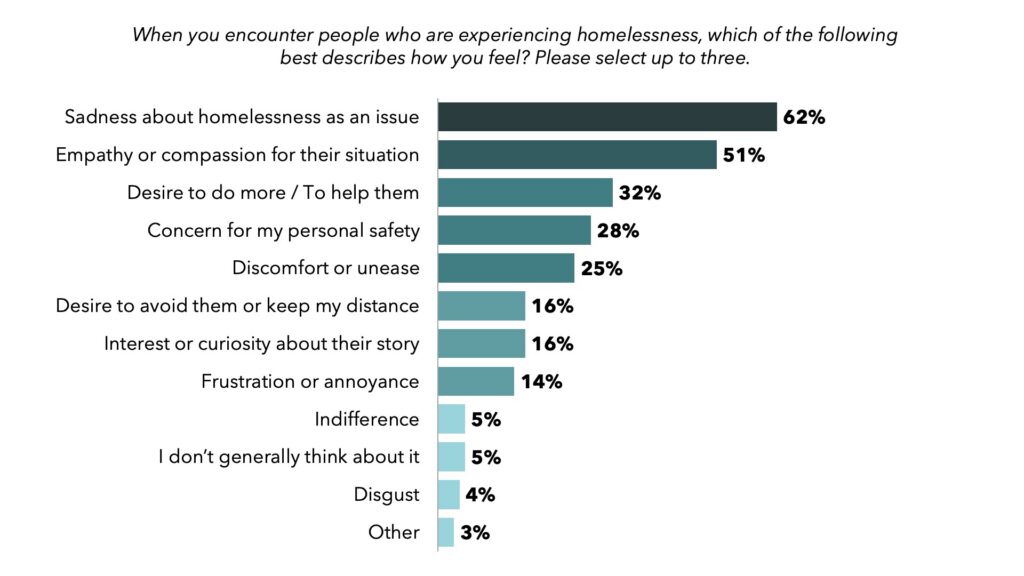
When asked how they feel when encountering people experiencing homelessness, Washingtonians are most likely to express sadness about homelessness as an issue and empathy or compassion for the person. They are more likely to feel a desire to do more or to help people experiencing homelessness than they are to feel unsafe or uncomfortable.
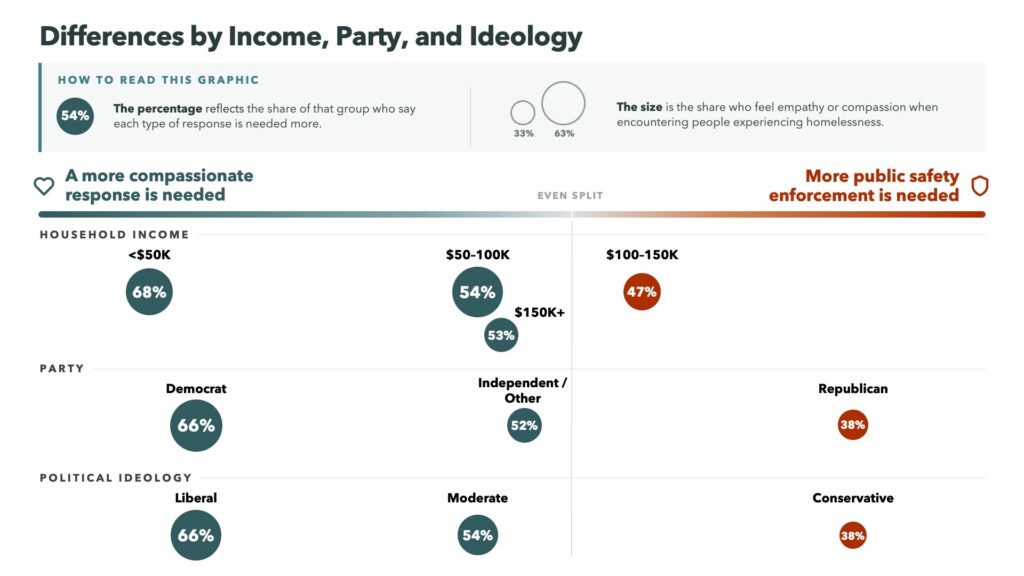
Given how most Washingtonians feel toward their unhoused community members, it follows that a majority want to see a more compassionate response at the state and local levels.
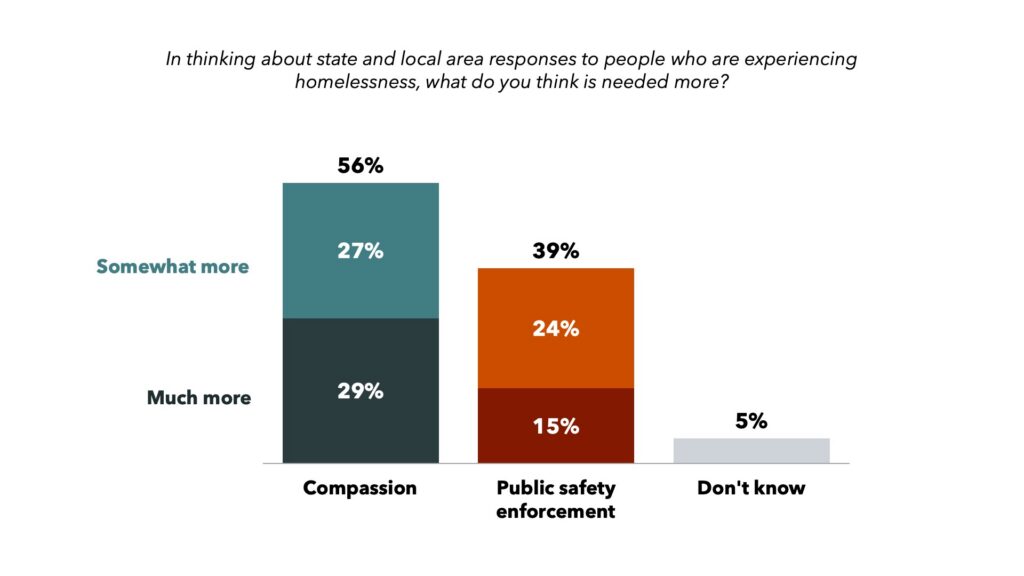
These results are consistent across areas of the state and regardless of how often people encounter people experiencing homelessness—in fact, those who do so daily are even more likely to want a much more compassionate response for their neighbors than those with less frequent interactions. Differences in opinion are present, however, in two main areas: income level and party or political ideology. Compared to their counterparts, Washingtonians with lower household income levels (<$100K, especially <$50K) and Democrats or liberals are more likely to express empathy, compassion, or a desire to do more, and to think that a more compassionate state or local response is needed over enforcement for public safety. In other words, those who may be closest to housing instability are more empathetic towards the issue, as are those with more socially liberal political values.
How to find common ground
While most Washingtonians want to see a more compassionate response, the visibility of the homelessness crisis shows up in how people assess public safety. Nearly half of Washingtonians believe homeless encampments in public spaces such as parks or sidewalks are among the biggest threats to public safety in their community, just ahead of mental health crises in public spaces, property crime, and open drug. However, there are some telling differences when we compare Washingtonians who prefer a compassionate response to those who prefer more public safety enforcement. Both rank encampments as the single biggest public safety threat. But look at what comes in second, and the picture gets more interesting: among residents who want a more compassionate response, mental health crises are the next-biggest concern; among those who want more enforcement, it’s public drug use, significantly higher than among the compassion-preferring group. Mental health and substance use are, in practice, deeply intertwined — so this is really a difference in which symptom each side notices first. Framing mental health and substance use as one intertwined problem rather than two competing ones turns the 19-point gap over drug use (49% vs. 33%) into what it actually is: two groups describing the same crisis from different angles.
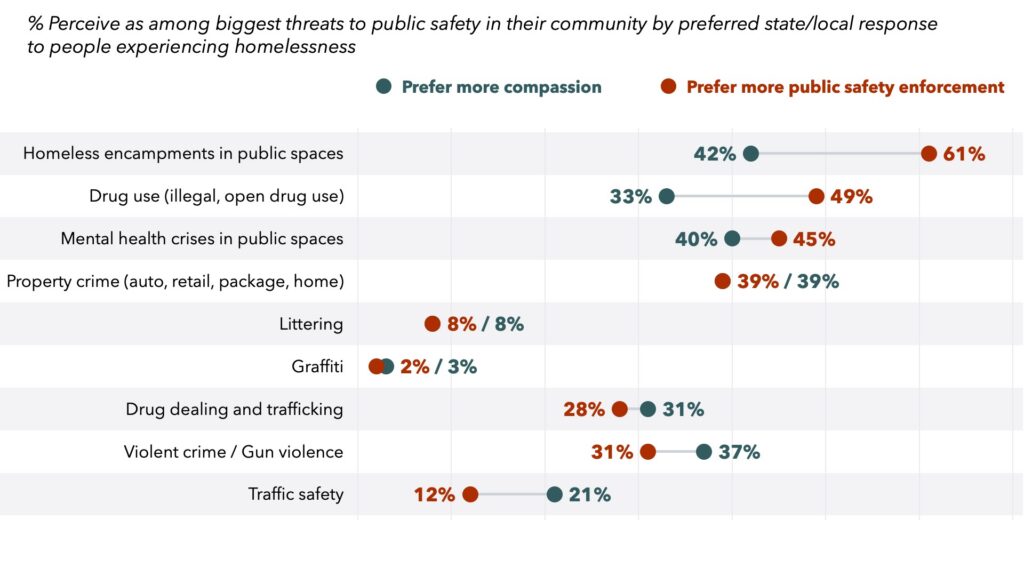
Therein lies the common ground. Even Washingtonians who prefer more public safety enforcement are naming drug use and mental health as the biggest threats to public safety, suggesting that both sides are leaning toward the same underlying conditions as the things they want to see addressed. DHM’s next Washington Pulse Survey, coming later this year, will delve deeper into public opinion on specific policies and services that Washingtonians favor regarding homelessness and housing.
Written by: Hannah Borenstein
About the Survey
Data from DHM Research’s Washington Pulse Survey, conducted March 17–25, 2026, among N=500 Washington residents (margin of error ±4.4%).