
More than half of working Californians now use AI on the job. But most expect it to hurt the state’s economy, depress good jobs, and widen inequality. Even the workers using AI day-to-day are only modestly more optimistic. Against a backdrop of high cost of living and weak confidence in the state’s economy, Californians are skeptical of AI and want guardrails.
Half of workers use AI — but few see a broad upside
In DHM’s April 2026 California Pulse, 54% of employed Californians say they use AI tools at work at least sometimes, including 23% who report using them often. Usage skews younger and more educated (66% of workers under 30, 64% of those with a college degree), but there is little difference across party lines. Democrats (56%), Republicans (53%), and No Party Preference voters (54%) report nearly identical rates.
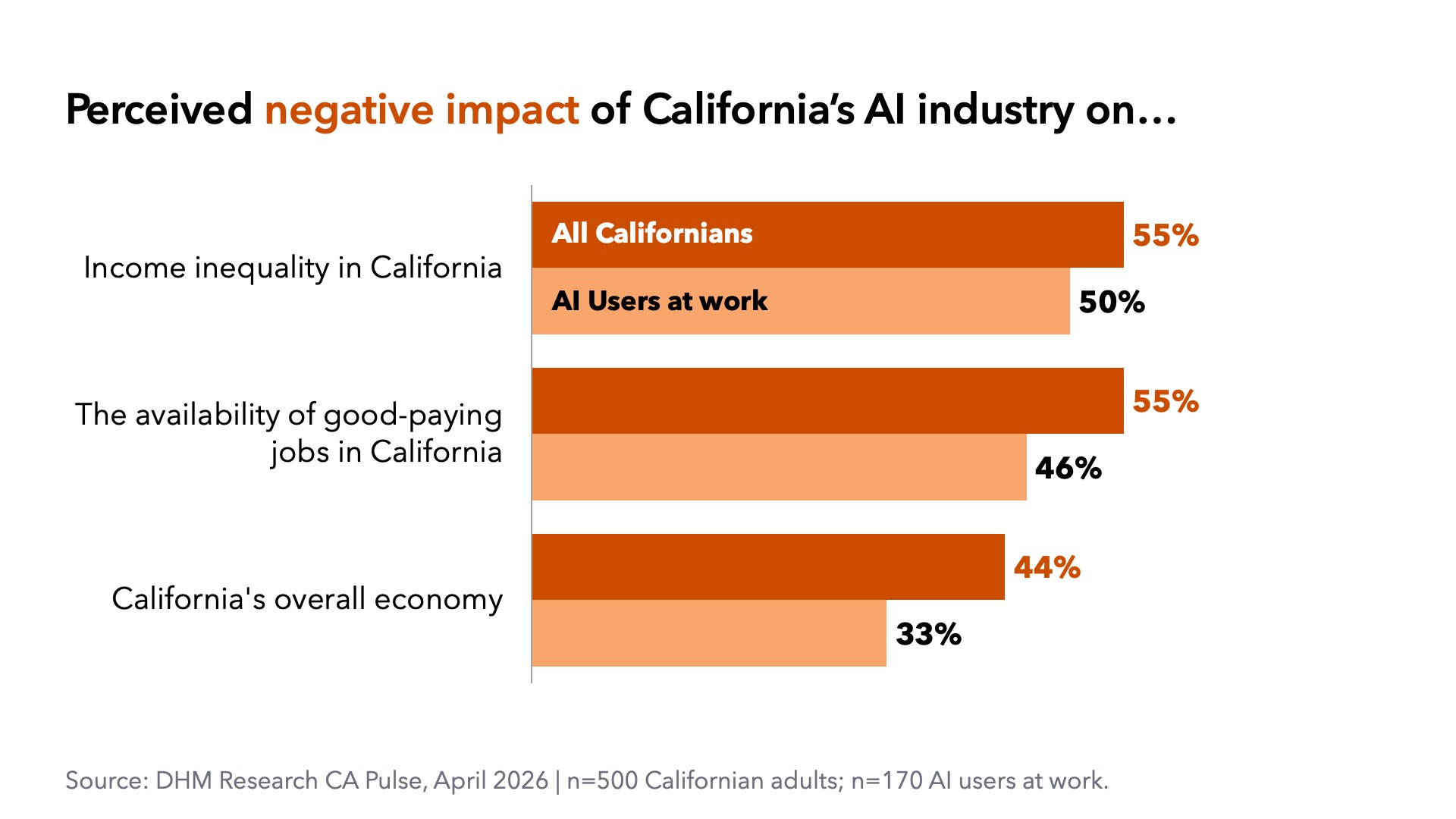
Usage, however, hasn’t translated into economic optimism. Pluralities of Californians say the AI industry is having a negative impact on income inequality (55%), the availability of good-paying jobs (55%), and the state’s overall economy (44%). While workers who actually use AI on the job are more positive than the general public, even they feel there is more harm than benefit on jobs and income inequality.
General concern is greater than fear of personal impacts
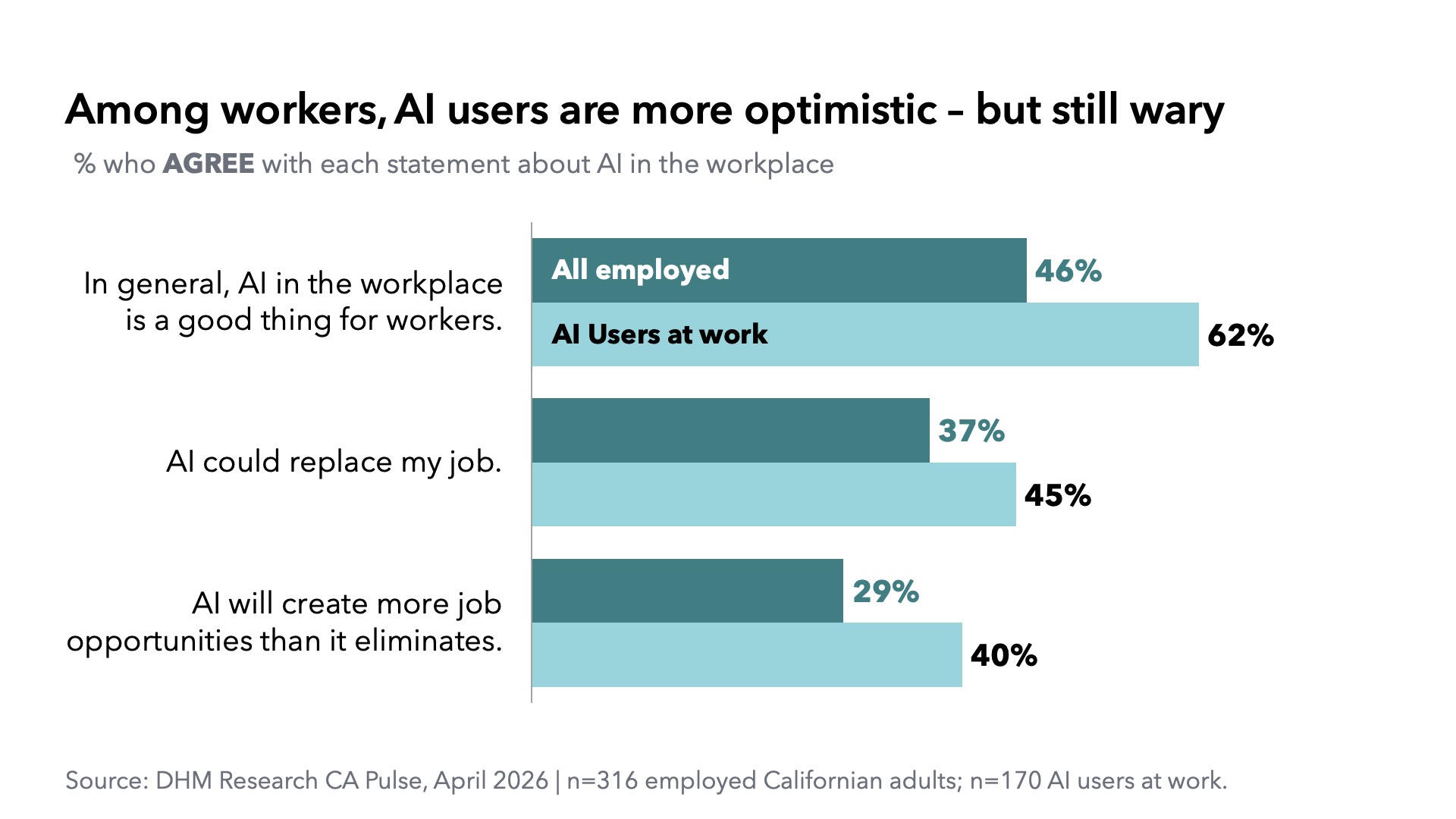
Californians are notably less worried about AI taking their own job than about what it will do to the workforce. Among employed Californians, just 37% think AI could replace their job, but 64% don’t believe AI will create more job opportunities than it eliminates, and they split roughly evenly on whether AI in the workplace is good for workers overall. The pattern suggests Californians see AI primarily as a systems-level risk to the labor market, but don’t yet see it as likely to negatively impact themselves personally.
Interestingly, workers who use AI day-to-day are far more likely to say AI is good for workers (62% vs. 27% among non-users), yet 45% of them think AI could replace their own job — eight points higher than among employed Californians overall. Personal familiarity with AI seems to make people more bullish on AI as a workplace tool and more clear-eyed about its risks to their own livelihood.
Demand for guardrails is a bipartisan issue
When asked who should set the rules, Californians are split: 42% want California to lead on AI regulation even if state rules diverge from federal standards, 38% prefer that rules be set nationally to avoid a patchwork, and 20% are unsure. That’s a real disagreement about jurisdiction, but a striking consensus about substance.
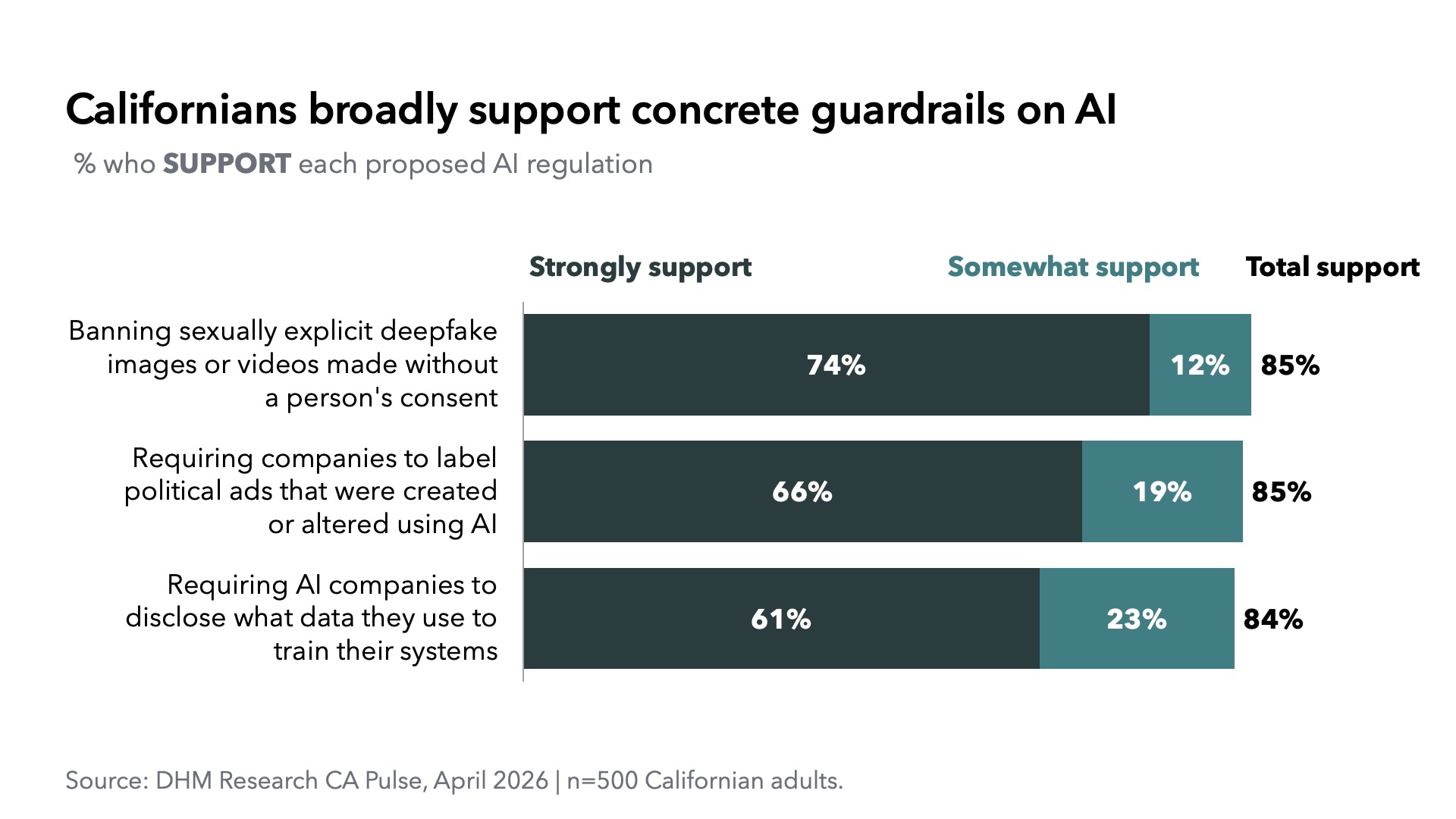
More than four in five Californians support each of three concrete proposals tested: banning sexually explicit deepfakes made without a person’s consent (85% support), requiring labels on AI-generated political ads (85%), and requiring AI companies to disclose what data trains their systems (84%).
Support is broadly shared across parties and across AI users and non-users alike — using AI does not soften the call for rules.
The frame: a state under economic strain
AI views are inseparable from the broader mood. Cost of living and inflation are by far the most named problem facing California. Majorities rate the state’s economy as poor (55%), say it is getting worse (56%), and call it a bad time to find a quality job in their community (59%).
California has long been synonymous with technological innovation, but innovation alone is not generating public confidence. Most Californians are not persuaded that AI will strengthen the state’s economy or improve conditions for workers, even as a majority of workers use it on the job. Until economic pressure eases, skepticism about AI’s role in the future of work is likely to persist, and the appetite for rules is likely to grow.
Written by: Chelsea Sektnan
About the Survey
The April 2026 California Pulse was conducted by DHM Research among 500 California adults from April 3–13, 2026. Results are weighted to reflect the statewide adult population.