
As ballots for California’s June gubernatorial primary begin arriving in the mail, the field may remain volatile, but there are some clear indications of what likely voters want from the state’s next governor.
DHM Research’s April 2026 California Pulse survey shows that likely primary voters, fueled by overall economic stress and dissatisfaction with the current direction of the state, want change, but do not agree on what it should look like. Voters widely prioritize economic and quality‑of‑life concerns, but even within the Democratic electorate, there are divisions on what path the next governor should take.
Economic Unease Fuels Calls for Change – Including Among Democrats
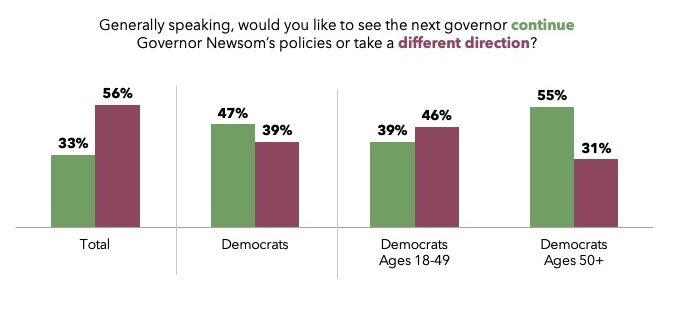
Almost half of Californians (48%) feel things in the state are on the wrong track and a third (32%) cite cost of living / inflation as the most important problem facing California today. Amid this backdrop of dissatisfaction and cost of living concerns, it is perhaps unsurprising that a majority of likely primary voters say they want the next governor to take the state in a different direction rather than continue Governor Gavin Newsom’s approach.
This desire for change is not confined to Republicans or independents. Democrats themselves are divided, revealing important fault lines within the party. The share of Democrats who want the next governor to continue Newsom’s policies falls shy of a majority (47%) while a nearly equal share (39%) express a desire for a new direction. This divide is especially notable by age, with a plurality of younger Democrats expressing a desire for a different direction.
Cost of Living Dominates Voters’ Expectations for the Next Governor
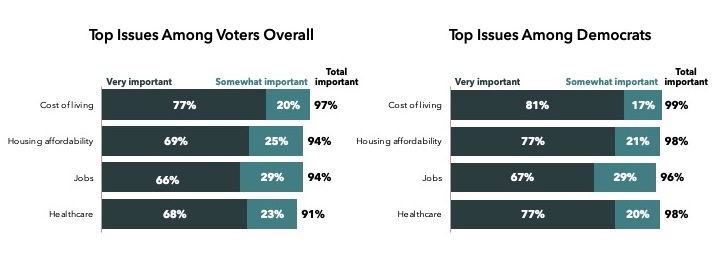
While voters report prioritizing many issues when deciding which candidate to vote for, there is a clear emphasis on cost of living and economic issues, reflecting the overall unease they feel about the direction of the state and concern about pocketbook issues. Large majorities say cost of living, housing affordability, healthcare, and jobs are very important in their decision of who they will vote for. Even among Democratic voters, issues tied to day‑to‑day economic security rise to the top.
Standing Up to Trump Matters, but State Issues Come First
Democratic voters nearly unanimously say a candidate “standing up to Trump” is important in evaluating who to vote for, with significant intensity (94% total important, 83% very important). More than two in three No Party Preference (NPP) voters also feel this is important in deciding who to vote for.
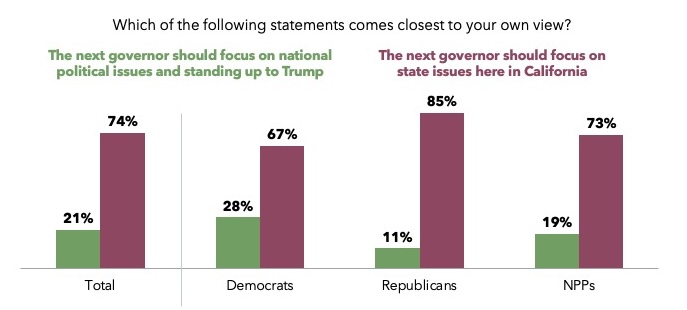
However, when asked to choose between the next governor focusing on national politics and standing up to Trump or on state issues, strong majorities across all parties pick the latter, again reflecting the prevailing concern with issues closer to home that impact day-to-day life.
Top-Two Dynamics Raise Strategic Voting Questions
The broad and fractured field of Democratic candidates has generated much discussion about the possibility of two Republicans advancing to the November election. However, a significant majority (60%) say they support the current top-two primary system, which was adopted by voters in 2010. Support is consistent across party registration.
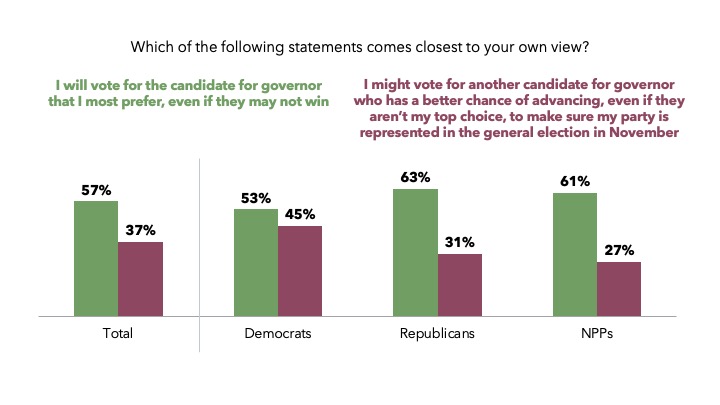
Democratic voters show a real unease about their party being locked out in November, with three quarters (77%) saying they are concerned about the possibility, including a majority (57%) who are very concerned. However, when asked to pick between voting for their preferred candidate or voting for another candidate from their party who may have a better chance of making it to the general election, a slight majority of Democrats still say they’d go with their preferred candidate. The share who say they’d back their preferred candidate in this scenario is even greater among Republicans and NPP voters.
About the Survey
Findings are based on the April 2026 DHM Research CA Pulse survey conducted April 3–13, 2026. The results in this post are among the subset of 452 likely June primary voters.